Ralph
A sandbox repository for learning and experimenting with AI. I'm using it as my parent Model Context Protocol server for other projects so that I can wire in additional features and plugins that are reusable between projects.

Log
Features
- CLAUDE.md — project-level instructions that guide Claude Code's behavior in this repo
- MCP server — local filesystem MCP server (
ralph-fs) exposing file operations as tools to Claude Code - RAG — local retrieval-augmented generation pipeline backed by SQLite, with hybrid search (sqlite-vec semantic + FTS5 keyword) and in-process embeddings (no daemon)
- AI assistant — "davo-bot 2000", a public citation-enabled chat widget, styled as a macOS terminal, grounded in the local RAG index and embeddable on any site
- Codebase graph — pinned, config-touching-nothing installer for
codebase-memory-mcp, a third-party code-graph MCP server shared across projects - Plugins — this repo is a plugin marketplace;
diagramgenerates editable Excalidraw system maps and installs into any project - Dual remotes — changes pushed to both GitHub and a self-hosted Gitea instance
Remotes
| Name | URL |
|---|---|
| origin | https://github.com/windhamdavid/ralph.git |
| code | https://davidwindham.com/code/ralph.git |
Reuse across projects
Ralph is the parent repo in the sense that capabilities are developed and versioned here and then used from anywhere. That reuse is not filesystem inheritance — sitting above Sites/ gives a project nothing. CLAUDE.md, .claude/settings.json, and .mcp.json are all scoped to the directory they live in and never propagate to a sibling.
What reaches other projects does so through one of three deliberate channels:
| Channel | Distributes | Reaches other projects via | Cost per session |
|---|---|---|---|
| Plugin marketplace | skills, commands, agents | /plugin install <name>@ralph | none until invoked |
| MCP server | tools (ralph-fs) | claude mcp add --scope user | tool schemas, always loaded |
| Pinned installer | third-party binaries | tools/*.sh + a registration you run | none until registered |
Choosing between them
Prefer a plugin. Skills load on demand, so a dozen of them cost nothing in a session that never uses one. This is the default for anything that is knowledge or procedure rather than a live capability.
Use an MCP server when you need a running process — something holding a database handle, a network connection, or an index. The cost is real and fixed: codebase-memory's schemas measure ~6,500 tokens injected into every session it's registered in, used or not, versus ~20,500 tokens for the whole of mcp-server/src. Register at user scope only when you'll genuinely use it everywhere; otherwise scope it per-project.
Use a pinned installer for third-party binaries. The artifact lands outside this repo (~/.local/bin) so a user-scope registration doesn't break when Ralph is moved or re-cloned; only the pinned installer is version-controlled. See tools/install-codebase-memory.sh.
Not a channel: project-specific tools
A fourth kind of thing lives here that is not a reuse channel: standalone CLIs in tools/, kept in Ralph because this is where tooling gets developed and versioned. They are not installed anywhere — you run them.
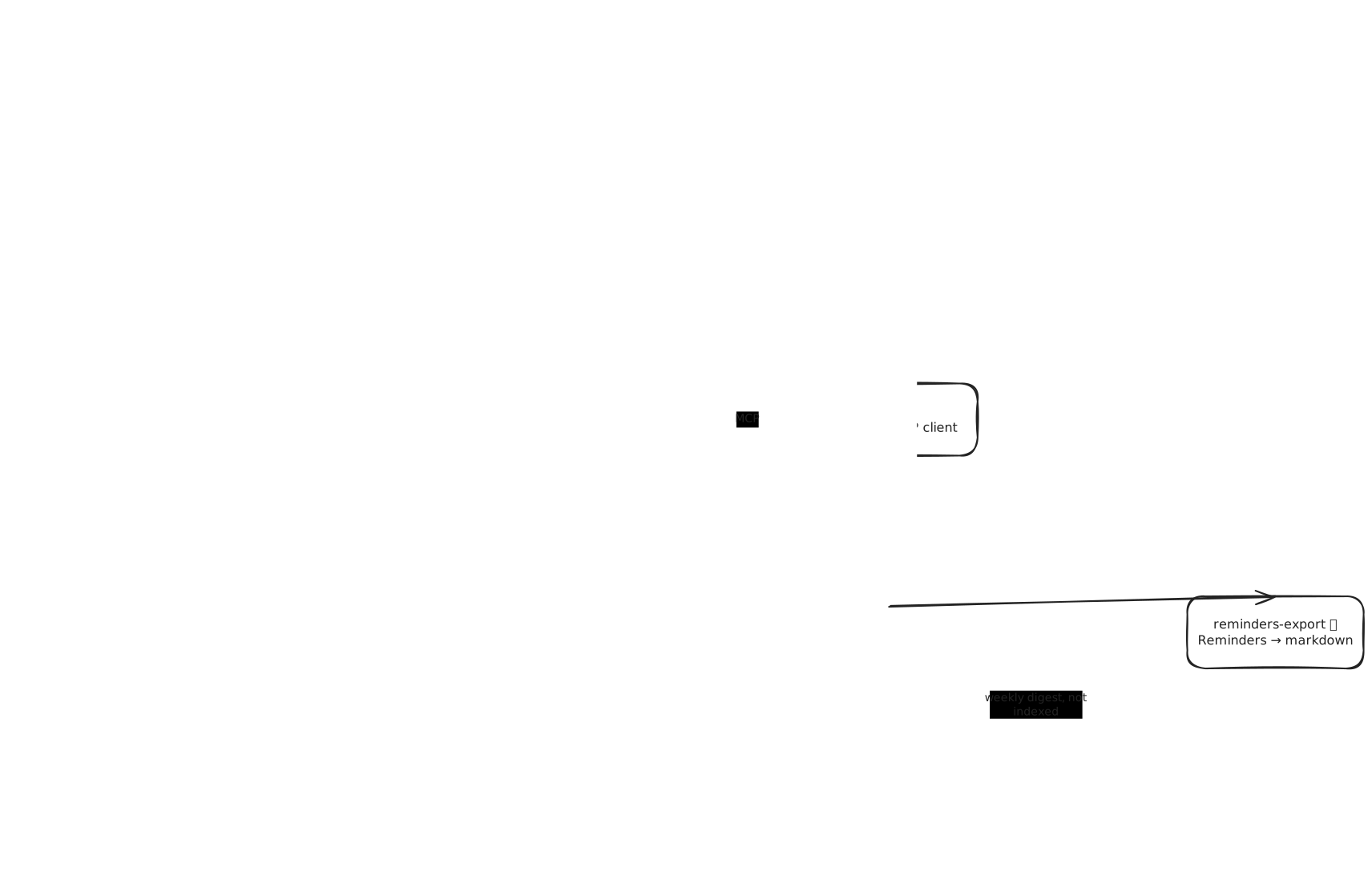
tools/last-fm-snapshot/— pulls a Last.fm listening snapshot and writes Docusaurus markdown intodaw_til. Project-specific: its output belongs to exactly one site.tools/reminders-export/— turns Apple Reminders into markdown the local chat reads for context. Feeds the substrate rather than any one project.
Note installers/ is a different thing again: it holds pinned installers for third-party binaries that land outside this repo. tools/ holds programs written here that produce files.
The distinction is worth keeping visible, because the two categories fail differently. A reuse channel is judged on what it costs every project that installs it. A project-specific tool is judged on whether its output lands somewhere appropriate — which is why the scrobble output is excluded from the RAG index: it is generated data with no prose to answer a question, and the corpus it would otherwise join is one a public widget quotes from.
What lives where
.claude-plugin/marketplace.json   ← the catalog other projects install from
plugins/<name>/                   ← one directory per plugin
  .claude-plugin/plugin.json
  skills/ commands/ agents/       ← auto-discovered by convention
tools/                            ← pinned installers for external binaries
mcp-server/                       ← the ralph-fs MCP server (TypeScript)
Adding a plugin means a directory under plugins/ and an entry in marketplace.json — no other wiring. Iterate against a local path (/plugin marketplace add /Users/david/Sites/ralph) and switch to windhamdavid/ralph once it's stable.
Models
Three models are in play, and they run in three different places:
| Model | Role | Where it runs |
|---|---|---|
Xenova/bge-small-en-v1.5 | embeddings (384-dim) — RAG indexing and query | in-process, Transformers.js / ONNX |
claude-haiku-4-5 | generation + citations for the public /api/ask | Anthropic API |
llama3.2 | generation for the local-only /api/chat | Ollama on stu, never deployed |
The split is what keeps the deploy small. Document vectors are baked into rag.db at ingest time on the
stu, so the hosted server only ever embeds the incoming question — no Ollama, no GPU, one Node process.
See Deployment.
nomic-embed-text may still be sitting in a local Ollama install. Nothing imports it — it predates the move
to in-process embeddings and can go with ollama rm nomic-embed-text.
Where the weights live
| Path | Holds | Override |
|---|---|---|
mcp-server/.model-cache | the ONNX embedding model (~130MB), kept outside node_modules so npm ci can't wipe it; ships with deploys | EMBED_CACHE_DIR |
~/.ollama/models | Ollama's blobs (llama3.2, plus anything else pulled) | OLLAMA_MODELS |
Swapping the embedding model
EMBED_MODEL overrides the embedder, but it is not a drop-in. Vectors from different models aren't
comparable, and the rag_embeddings vec0 table fixes its width at create time (EMBEDDING_DIM = 384 in
src/rag/db.ts), so a model of a different dimensionality means recreating that table and reindexing both
collections — not just changing the name. RAG_MAX_DISTANCE, the relevance gate that produces the widget's
"I don't know", is tuned to the current model's distance distribution and has to be re-tuned with it.
Upgrade assessment — working notes
Captured 2026-08-30 from a planning conversation about swapping the embedder, adding a reranker, and moving model weights to an external volume. None of this is implemented yet; it records what the repo actually does today and what an upgrade would cost.
The reranker and the model relocation are both good calls, but three of the premises didn't match what's in the repo.
The embedding model isn't nomic-embed-text
embeddings.ts runs Xenova/bge-small-en-v1.5 in-process via Transformers.js — 384-dim, no daemon.
nomic-embed-text is a leftover 274MB Ollama pull that nothing imports; the only Ollama consumer left is
llama3.2 for local.ts's /api/chat. So there's no nomic→X swap; there's a bge-small→X swap, and the
column is float[384], not 768.
That also changes the deployment math. /api/ask embeds the incoming question at query time on woozie,
so whatever you pick has to run there on CPU. bge-small is 128MB ONNX and ~10ms. Qwen3-Embedding-0.6B is
~600M params — several hundred MB quantized and a couple orders of magnitude slower per query. That's the
real constraint on the embedding swap, not disk.
The reranker is the strong idea, and it's independent
retrieve.ts already does vec KNN + FTS5 BM25 → RRF → relevance gate, pulling CANDIDATES = 30 and cutting
to topK. A cross-encoder slots in exactly there: rerank the 30 fused candidates down to 6. Crucially it
needs no schema change and no reindex — pure query-time addition, rollback is an env flag. And its own
comment at retrieve.ts:5-8 says the embedder "compresses this corpus into a narrow distance band", which is
the exact failure a reranker fixes. Do this first; it may make the embedding swap unnecessary.
Rollback: parallel vec table, not a second collection
collection is a column on rag_documents; the vec0 dimension is fixed per table. A 1024-dim vector can't
go into rag_embeddings under any collection value. Duplicating the corpus into a second collection would
also double rag_documents and skew BM25 stats, so you'd no longer be comparing like with like.
Instead: add rag_embeddings_1024 as a second vec0 table sharing rowid with the same rag_documents. Both
vector spaces over identical chunks, one env var picks which table retrieval reads, rollback is instant, and
the A/B is clean. Then it's genuinely one commit — new table + backfill script + read switch — with nothing
destructive.
One hazard to plan for: DEFAULT_MAX_DISTANCE = 0.9 is tuned to bge-small's distance distribution, and it's
what produces the off-topic "I don't know" on the public widget. A new embedder invalidates that constant and
silently changes what the widget refuses to answer. It needs re-tuning as part of the swap, and the eval set
should include the off-topic cases, not just the hits. (Note the sqlite3 CLI here has no vec0 module, so
eval tooling has to go through node.)
Models on Blue25: yes for Ollama, no for the embedder
Disk headroom is the reason, though the numbers need reading carefully. The APFS container is 94.5%
consumed with 27.2GB not allocated, and df reports ~25GiB available — but Settings > Storage says ~150GB,
because it counts purgeable space and df doesn't. The difference is mostly one Time Machine local
snapshot that diskutil apfs listSnapshots disk3s5 marks Purgeable: Yes / "limits the minimum size of
APFS Container disk3".
So a 20GB pull would probably succeed — macOS evicts that snapshot under pressure. The objection isn't a hard wall, it's that the headroom is reclaimable-on-demand rather than owned: the OS chooses when to free it, and doing so discards a local restore point. None of this is an Ollama limit — Ollama has no quota and writes until the volume fills. Blue25 has 1.4TB of actually-unallocated space.
Ollama runs only on stu here, so OLLAMA_MODELS=/Volumes/Blue25/_ralph/MODELS/ollama is clean; worst case
the volume is out and /api/chat is down. Ollama isn't running as a service right now
(brew services shows none), so a shell env var covers ollama serve — but the macOS app would need
launchctl setenv.
Leave .model-cache on the internal disk though. It's 128MB, it gets rsynced to woozie as part of the deploy
artifact, and it's on the critical path for the thing that must always work. Moving it to a separate volume
buys 128MB and adds a mount-order failure mode where Transformers.js silently re-downloads from HF. If a much
larger embedder lands later, relocate those weights and keep a fallback path.
On Qwen 3.6 35B-A3B
Specs per canirun.ai: 36B total parameters, 3.0B active, sparse MoE (256 experts, 8 active), 256K context, released 2026-04. It behaves like a small model for throughput while needing the full weight set resident.
| Quant | Size | On a 36GB M4 Max |
|---|---|---|
Q4_K_M | 18.9 GB | comfortable — this is the one to pull |
Q5_K_M | 23.6 GB | borderline against Metal's default wired limit (~75% of RAM) |
Q6_K | 28.2 GB | needs iogpu.wired_limit_ratio raised |
Q8_0 | 37.4 GB | exceeds total RAM |
Stated minimum RAM is 20.1GB and recommended 33.5GB; the recommendation is aimed at the larger quants, so
Q4_K_M on 36GB is fine and leaves ~15GB for the OS and KV cache.
The 256K context is irrelevant here — /api/chat sends TOP_K = 5 chunks of ≤1500 chars, so a couple of
thousand tokens. What is relevant: local.ts sets no options.num_ctx on its Ollama request, so it
inherits Ollama's small default and silently truncates from the front. Worth fixing before judging any
retrieval change on that path — otherwise better-retrieved chunks get dropped before the model sees them.
Two intended uses, and they pull in different directions:
- Generation for
/api/chat— swapsllama3.2inlocal.ts. Short contexts, low memory, easy. - A local coding assistant in VS Code — long contexts over real files, running alongside VS Code,
Node, and whatever else. This is the demanding one:
Q4_K_M's 18.9GB plus an Electron host plus a KV cache that grows with context is what will actually strain 36GB. Budget context deliberately (32–64K, not 256K) and treatnum_ctxas a memory knob, not a free parameter.
Neither is on the path that ships. Public /api/ask generation is locked to Haiku 4.5, so retrieval work
validated here still has to be measured against the eval set, not against how the local chat feels.
VS Code needs a client extension to talk to Ollama — none is installed today. Continue.dev was the usual recommendation but has been acquired by Cursor and is no longer independent; the open-source code remains public. Current options: Cline (agentic, open source, takes an Ollama base URL), Roo Code (a Cline fork with per-mode model selection — useful for local-cheap / Claude-hard splits), or Twinny (light, local-first, completion-focused).
Of those, Kilo suits this setup best: per-mode model selection (Code/Architect/Debug/Custom) maps onto
the local-cheap / Claude-hard split, and its Ollama docs name the settings that actually matter here — an
explicit num_ctx with a 32k recommended floor, and an adjustable request timeout (default 10 minutes,
itself a fair warning about local prefill). Cline is the more established agent and has a "Use Compact
Prompt" mode for local inference — a setting that exists because its default system prompt is large enough
to hurt when you're spending from a 32k budget.
Also under consideration, both editors rather than extensions — they replace VS Code instead of plugging into it:
- Zed — standalone, written in Rust, open source. Agentic editing, edit prediction, inline assistant, parallel agent threads, and external agents over ACP (Claude Agent, Codex). Its landing page doesn't state Ollama support; verify before counting on it.
- Void — a VS Code fork, so themes, keybinds, and settings transfer in one click. Open source, YC-backed (Glass Devtools), in beta. Supports Ollama directly, plus FIM models for tab completion, and Agent/Gather/chat modes with checkpoints.
The fork question is the real trade: Void keeps the VS Code muscle memory, Zed abandons it for speed and a cleaner agent story. Neither is a small switch, and Void's beta status argues for waiting.
Note that completion and chat want different models: tab completion needs fill-in-the-middle support, which instruct models like 35B-A3B handle poorly. The usual setup is a small coder base model for FIM plus the larger model for chat and agent work.
Suggested order
- Ollama models → Blue25 (cheap, independent, unblocks big pulls)
- Build a fixed eval set — queries with expected source URLs, plus off-topic cases
- Reranker behind an env flag, measured against the eval set
- Only then the embedding swap, via parallel vec table + re-tuned distance gate
M5 Ultra
Open question: whether to replace stu — a 36GB M4 Max Mac Studio (Mac16,9) — with a 96GB M5 Ultra Mac
Studio. Note this is a same-class upgrade: stu is already an always-on desktop, so the only variable is
memory (and whatever bandwidth an Ultra adds over a Max). Recorded here because the Qwen sizing above is
the concrete case for and against it. The M5 Ultra's own specs are taken as a premise — core counts and
bandwidth aren't verified here, and only the memory figure drives the argument below.
What 96GB actually changes
Metal reserves roughly 75% of unified memory for the GPU by default, so usable budget goes from ~27GB to ~72GB. Against Qwen 3.6 35B-A3B:
| Quant | Size | 36GB M4 Max | 96GB M5 Ultra |
|---|---|---|---|
Q4_K_M | 18.9 GB | fits, ~8GB spare | trivial, large KV headroom |
Q5_K_M | 23.6 GB | borderline at the wired limit | comfortable |
Q6_K | 28.2 GB | needs iogpu.wired_limit_ratio raised | comfortable |
Q8_0 | 37.4 GB | exceeds total RAM | comfortable |
F16 | 74.3 GB | impossible | possible, past the default wired limit |
The honest reading: stu already runs the model you'd actually run. Q4_K_M fits today with room to
spare, and the quality gap from Q4 to Q8 on a 3B-active MoE is real but modest. The upgrade doesn't
unlock the stated use case; it makes it roomier.
The arguments that do hold
- Context, not weights. The binding constraint for a coding assistant is the KV cache, which grows with context while the weights stay fixed. 96GB is what turns "budget 32–64K carefully" into "use the 256K".
- Concurrency. At 36GB the model competes with VS Code's Electron host, Node servers, and Claude Code for the same pool. 96GB means it stops being a zero-sum allocation.
- Bandwidth. An Ultra is two Max dies, so memory bandwidth should roughly double — and bandwidth is what sets token throughput. Not verified for M5; worth confirming before it counts as a reason.
- Ingest and reindex currently pin
stuwhile they run. More headroom makes that a background job rather than a stop-everything one. - Headroom for the next model, which will be larger. 36GB is already the ceiling for this one at high quant.
The arguments against
- Nothing that ships is affected. Public
/api/askruns Haiku 4.5 on woozie, and the RAG embedder is a 128MB CPU model. Neither gets faster or better with more local memory — this is purely an experimentation purchase. - It doesn't fix the disk problem. The 95%-full volume is
stu's boot disk, and a new box starts the same clock unless the storage habits change. Blue25 relocation is the cheap fix either way. - It's not what's blocking the RAG work. The reranker needs no new hardware, and the eval set is what decides whether retrieval improved. Buying a Studio answers a different question than the one being asked.
Where that leaves it
Justified if local models become a daily driver — a coding assistant used in earnest, or an always-on host
for the local stack. Not justified by the RAG upgrade, which runs the same on both machines. The cheap moves
(OLLAMA_MODELS → Blue25, Q4_K_M, a num_ctx that fits) should come first, if only because they establish
whether local models get used enough to warrant the box.
MCP Server
mcp-server/ contains a local Model Context Protocol file system server (ralph-fs) written in TypeScript. It exposes file system operations to Claude Code as tools, scoped to a set of allowed directories.
Tools
| Tool | Description |
|---|---|
read_file | Read file contents with optional encoding (utf8 / base64) |
write_file | Write content to a file, creating it if it doesn't exist |
list_directory | List files and directories at a given path |
create_directory | Create a directory, including any missing parent directories |
file_info | Get metadata (size, dates, permissions, type) for a file or directory |
delete_file | Delete a file or directory (non-empty directories require recursive: true) |
search_files | Search for files matching a glob pattern |
Path safety
All paths are resolved against a primary root (ROOT_DIR) and validated against an allowlist before any operation is performed. Requests that escape the allowed directories are rejected with an InvalidParams error. The prefix test is case-insensitive on macOS and Windows, matching the filesystem — otherwise /Users/david/sites/... would be rejected for a file plainly inside /Users/david/Sites/....
The allowlist is env-driven, so the same build can serve different directory sets without a rebuild. Defaults live in mcp-server/src/utils/path-safety.ts.
| Variable | Default | Purpose |
|---|---|---|
RALPH_ALLOWED_DIRS | ralph, daw_til, srh under /Users/david/Sites | PATH-style list (:-delimited) of accessible roots |
RALPH_ROOT_DIR | /Users/david/Sites/ralph | Base for resolving relative paths |
ROOT_DIR is deliberately not ALLOWED_DIRS[0] — widening the allowlist (say, to all of /Sites) shouldn't silently change what relative paths resolve against, or where the RAG index lands.
Configuration
The server is registered in .mcp.json and enabled via .claude/settings.local.json:
// .mcp.json
{
  "mcpServers": {
    "ralph-fs": {
      "type": "stdio",
      "command": "node",
      "args": ["/Users/david/Sites/ralph/mcp-server/dist/index.js"],
      "env": {
        "RAG_DB_PATH": "/Users/david/Sites/ralph/.rag/rag.db",
        "RALPH_ALLOWED_DIRS": "/Users/david/Sites",
        "RALPH_ROOT_DIR": "/Users/david/Sites/ralph"
      }
    }
  }
}
Widening RALPH_ALLOWED_DIRS to all of /Sites is a real tradeoff: any session that can reach this server can then read and write across every site. Fine on a personal machine, but the allowlist stops being a meaningful boundary at that point.
Using it from other projects
A project-scoped .mcp.json only loads when the cwd is that project. To make ralph-fs available everywhere, register it once at user scope — the code stays here, only the registration moves:
claude mcp add --scope user ralph-fs \
  --env RAG_DB_PATH=/Users/david/Sites/ralph/.rag/rag.db \
  --env RALPH_ALLOWED_DIRS=/Users/david/Sites \
  --env RALPH_ROOT_DIR=/Users/david/Sites/ralph \
  -- node /Users/david/Sites/ralph/mcp-server/dist/index.js
Note this covers MCP tools only. Slash commands, agents, and skills are distributed separately, by publishing them as a plugin and adding this repo as a marketplace.
Setup
cd mcp-server
npm install
npm run build   # compiles TypeScript to dist/
npm start       # run the server directly
Codebase graph
codebase-memory-mcp is a third-party MCP server that indexes a repository into a persistent code graph, so an agent can query structure instead of reading files. It isn't vendored here — it's a C static binary distributed via GitHub Releases, and nothing in mcp-server/ links against it. This repo owns only the pinned installer.
Installing
./tools/install-codebase-memory.sh              # -> ~/.local/bin
./tools/install-codebase-memory.sh --dir=/path  # somewhere else
./tools/install-codebase-memory.sh --ui         # variant with the 3D graph UI
The script pins an exact release, downloads the archive for your platform, verifies its SHA-256 against checksums.txt, verifies its Sigstore provenance with gh attestation verify, ad-hoc-signs it on macOS (the binary ships unsigned, so Gatekeeper otherwise kills it), smoke-tests --version, and prints the registration command.
It changes no configuration. That's the reason it exists rather than upstream's curl | bash: upstream's install subcommand rewrites MCP client config across ~43 "client surfaces", which includes ~/.claude.json — where the user-scope ralph-fs registration lives. Upstream also always fetches latest; at pre-1.0 RC that's an unannounced binary swap under every project at once. Here, updating means bumping VERSION at the top of the script, in git, where it's reviewable.
A checksum only proves the archive matches a file served by the same host that served the checksum, so a failed attestation is treated as fatal while a missing gh is not — an actively bad signal differs from an unchecked one.
Why the binary lives outside this repo
A user-scope MCP registration is a single absolute path consulted from every project. Pointing it inside Sites/ralph would break the server in every project the moment this repo is moved, renamed, or re-cloned — so the artifact goes to ~/.local/bin and only the installer is version-controlled.
tools/install-codebase-memory.sh   ← committed; pins the version
~/.local/bin/codebase-memory-mcp   ← the artifact it produces
~/.cache/codebase-memory-mcp/      ← all project graphs (CBM_CACHE_DIR)
Leave CBM_CACHE_DIR at its default for the same reason.
Using it across projects
Unlike ralph-fs, this server isn't scoped to a working directory — one instance manages many repos, each indexed by absolute path and queried by name. So it needs one registration, not one per project:
claude mcp add --scope user codebase-memory -- ~/.local/bin/codebase-memory-mcp
index_repository(repo_path="/Users/david/Sites/daw_til")   # once per repo
list_projects()                                            # what's indexed
<query tools>(project="Users-david-Sites-daw_til")         # from any project
Project names are derived from the absolute path (/Users/david/Sites/daw_til → Users-david-Sites-daw_til), not the bare directory name — use list_projects to get the exact string.
Both repos then live in one store and are queryable from any session, regardless of cwd:
{"projects":[
  {"name":"Users-david-Sites-ralph",   "root_path":"/Users/david/Sites/ralph",   "nodes":469,  "edges":867},
  {"name":"Users-david-Sites-daw_til", "root_path":"/Users/david/Sites/daw_til", "nodes":3474, "edges":3675}
]}
Indexing is fast (~5s for ralph, ~8s for daw_til, daemon startup included) and applies .gitignore plus its own skip-lists without configuration — daw_til's node_modules, .docusaurus, build, and static were all excluded automatically.
Testing it without registering anything
The binary is a CLI as well as an MCP server, so it can be exercised end to end before it's wired into any client. Point CBM_CACHE_DIR somewhere disposable and nothing outside that directory is touched:
export CBM_CACHE_DIR=/tmp/cbm-test
codebase-memory-mcp cli index_repository '{"repo_path":"/Users/david/Sites/ralph"}'
codebase-memory-mcp cli --json search_graph --project Users-david-Sites-ralph --query "safePath" --limit 5
codebase-memory-mcp cli --json query_graph --project Users-david-Sites-ralph \
  --query "MATCH (a)-[r]->(b) WHERE b.name = 'safePath' RETURN a.name, type(r), a.file_path"
Note --json goes before the tool name; after it, it's parsed as a tool flag. Bare cli <tool> prints human-readable text instead.
3D graph visualization
Requires the --ui variant — the standard binary doesn't embed the frontend. Two things are counterintuitive:
codebase-memory-mcp --ui=true --port=9749   # persists config, then EXITS — serves nothing
codebase-memory-mcp daemon start            # the daemon owns the UI
open http://localhost:9749
The first command looks like it should start a server and doesn't; the daemon is what serves the UI, so daemon start is the step that actually brings it up. And the daemon starts permanent — it survives session end and idle, so retire it deliberately:
codebase-memory-mcp daemon stop
daemon start may warn the daemon did not accept the UI configuration and then serve the UI correctly anyway — observed on v0.9.1-rc.1. Check daemon status, which reports the bound URL, before chasing it.
What it's good for, and what it isn't
Indexing both repos makes the split obvious:
| ralph | daw_til | |
|---|---|---|
| Nodes / edges | 469 / 867 | 3474 / 3675 |
| Dominant node type | Function, Method | Section (2541 markdown headings) |
search_graph results | accurate | 0 for every query |
search_graph's BM25 index covers code symbols and filters non-code labels as noise, so on a docs repo it returns nothing even though the nodes exist — they're reachable only via query_graph Cypher. This is a code tool. For daw_til's prose the RAG index above is the right instrument and already works; the graph earns its keep on repos like mcp-server/, where it answers questions grep can't:
MATCH (a)-[r]->(b) WHERE b.name = 'safePath' RETURN a.name, type(r), a.file_path
→ 10 CALLS edges, one per tool handler  (verified against grep: exactly 10)
The daw_til nodes are indexed, just not searchable — worth knowing so an empty search_graph isn't mistaken for a failed index:
search_graph --query "ubuntu"                            → total: 0
query_graph  "MATCH (n:Section) RETURN n.name, n.file_path LIMIT 3"
  Tweets          lists/tweets_follow.md
  "Future Build"  notes/house/build.md
  Concepts        notes/house/build.md
Because graphs are keyed by project inside the shared cache, daw_til's graph is queryable from a Ralph session and vice versa.
Tradeoff: a user-scope registration loads all 15 of its tools into every session in every project, used or not. If that's noise, register it per-project instead — the binary path and shared cache are unchanged, only the scope moves.
Measured on this repo: its MCP tool schemas are ~24KB (~6,500 tokens) loaded into every session whether or not a tool is called, while Ralph's entire TypeScript source is ~20,500 tokens. On a codebase this size the graph can't pay for itself — it earns its keep on large, unfamiliar repos where it saves you from opening files you didn't need.
Plugins
.claude-plugin/marketplace.json makes this repo a plugin marketplace, which is how work developed here becomes reusable in other projects. Unlike an MCP server, a plugin's skills cost nothing until invoked — the lesson from the token measurement above.
/plugin marketplace add /Users/david/Sites/ralph   # local path, for iterating
/plugin marketplace add windhamdavid/ralph         # from GitHub
/plugin install diagram@ralph
diagram — Excalidraw system maps
plugins/diagram/ generates editable .excalidraw files for explaining a system to people who don't have the code in their head.
python3 plugins/diagram/skills/excalidraw/scripts/build_excalidraw.py \
  --spec plugins/diagram/examples/ralph-layout.spec.json \
  --out ralph-layout.excalidraw
Open the result at excalidraw.com or in VS Code via the pomdtr.excalidraw-editor extension. plugins/diagram/examples/ holds a worked example — this repo drawn as its three reuse channels.
Style comes from a named theme rather than being restated per diagram; slate (white line art on a slate canvas, sans-serif, no fills) is the default the skill reaches for, and individual keys override it.
Why a script rather than the model emitting JSON. Excalidraw elements carry ~25 fields each plus two-way references between shapes, their labels, and arrows. Miss one backlink and the file still opens — blank, or with every label silently dropped. The script owns the schema and refuses to write a file that fails validation, so a clean exit means it will render.
build_excalidraw.py --validate diagram.excalidraw
Checks label/container backlinks, arrow bindings, and z-order indices. That last one is subtle: Excalidraw sorts elements by comparing index as a string, so unpadded values put a10 before a2 and the layering scrambles once a diagram exceeds nine elements — the indices are zero-padded for that reason.
Output is deterministic: element seeds derive from a hash of the node id, so regenerating an unchanged spec produces a byte-identical file and edits give clean diffs.
Sharing with a non-technical audience: export to .excalidraw.svg. It renders as an ordinary image anywhere — GitHub, a README, a slide — while remaining a fully editable drawing.
Not needed: an Excalidraw Plus account or API key. This writes files locally and makes no network calls. The Excalidraw+ MCP is a separate, complementary thing — it syncs diagrams to a hosted Plus workspace for shareable links. If you add it, register it at user scope, never in this repo's .mcp.json: that file is committed and pushed to two remotes, one of them public.
RAG
The MCP server includes a local retrieval-augmented generation (RAG) pipeline that lets Claude index and semantically search markdown and text files entirely offline.
How it works
- Ingest — a file is read, split into overlapping chunks, and each chunk is embedded in-process via Transformers.js (
bge-small-en-v1.5, 384-dim ONNX — no daemon). Embeddings are L2-normalized; queries get BGE's retrieval instruction prefix, documents are raw. - Store — chunks and their float32 embeddings are persisted in a SQLite database (
<root>/.rag/rag.db) using the sqlite-vec extension for KNN vector search, with a parallel FTS5 full-text index over the chunk text for keyword search. - Search — a query is run through both retrievers (semantic + keyword) and the results are merged with Reciprocal Rank Fusion. See Hybrid search.
RAG tools
| Tool | Description |
|---|---|
rag_ingest_file | Chunk, embed, and index a single .md or .txt file. Re-ingesting replaces existing chunks. |
rag_ingest_directory | Recursively walk a directory and ingest every .md / .txt / .mdx file. |
rag_search | Hybrid search (semantic + keyword, RRF-fused) returning the top-k most relevant chunks with source and match info. Off-topic queries return nothing. |
rag_list_documents | List all indexed source files with chunk count and last-ingested timestamp. |
rag_delete_document | Remove all indexed chunks for a given source file. |
Collections
Every chunk is tagged with the published corpus it belongs to, and the vocabulary is a closed set of two — daw (davidwindham.com site content) and daw_til (the daw_til docs site) — defined in mcp-server/src/rag/collections.ts.
This is a namespace, not a category label. The index backs a public widget that quotes what it retrieves, so before collections existed, pointing rag_ingest_directory at any project wrote straight into the corpus the widget cites from, with nothing to distinguish site content from a scratch repo's notes. Both ingest tools now require a collection, so an ingest that can't name one fails instead of quietly publishing.
Retrieval filters to the collections it was asked for. /api/ask passes PUBLIC_COLLECTIONS explicitly at the public boundary; the local chat passes every collection in its own database, which is safe because that process is never deployed and never reaches a cloud model. The filter is applied inside the retrievers (sqlite-vec's rowid IN (…) pre-filter and an FTS5 AND), not over their output — post-filtering a global top-30 would starve the smaller collection whenever the other dominates the neighborhood.
Rows matching no collection are unreachable rather than deleted: retrieval names the collections it wants instead of excluding a blocklist, so anything unrecognized fails closed. rag_list_documents surfaces them under (no collection) for cleanup.
Adding a third collection means editing that file — deliberately, so it stays a review checkpoint rather than something an agent can mint mid-session.
Chunking strategy
Text is chunked in mcp-server/src/rag/chunker.ts:
- Split on markdown headings (
#–######) to respect document structure. - Merge heading-only sections into the following section — a lone
# WordPressheading never becomes its own contentless chunk; instead it prefixes the content it introduces. - Cap chunk size at 1 500 characters: oversized sections split on blank lines (paragraphs), and any single paragraph still over the cap is hard-split at whitespace boundaries (so a wall of text with no blank lines can't produce a giant chunk).
- Overlap — a 150-character overlap is prepended to each chunk (except the first) so context is preserved across boundaries.
- Drop noise — fragments under 40 characters are discarded (keeping at least one chunk per non-empty document).
The earlier version produced ~200 heading-only fragments and one 81 KB mega-chunk (of which only the first 2 KB was ever embedded); both polluted retrieval and are eliminated by steps 2–3.
Hybrid search
Pure vector search alone is brittle on a corpus like this — small embedding models compress text into a narrow distance band, so short queries pick up spurious neighbours and obvious lexical matches can get buried. The fix is hybrid retrieval (mcp-server/src/rag/retrieve.ts):
query ──┬─► sqlite-vec  (semantic, normalized L2 ≈ cosine)  → top 30
        └─► FTS5 + BM25 (keyword, porter-stemmed)           → top 30
                   │
                   ▼
        Reciprocal Rank Fusion (k=60) → relevance gate → top-k
- Two retrievers. The semantic side embeds the query (with BGE's retrieval instruction prefix) and runs a KNN search over
rag_embeddings. The keyword side runs a BM25 query over therag_ftsFTS5 index. - Reciprocal Rank Fusion (RRF). Each result contributes
1 / (60 + rank)to its document's score, summed across both lists. Fusing by rank position avoids having to compare an L2 distance against a BM25 score directly. A chunk that ranks well in both retrievers wins; a strong hit in either is still surfaced. - Relevance gate. A chunk is kept only if it's a strong semantic match (normalized L2 distance ≤
RAG_MAX_DISTANCE, default0.9) or a keyword hit. The keyword path ignores stopwords, so an all-stopword query like "who made this" registers no keyword hit and, with nothing near in vector space, returns nothing — which the chat/ask endpoints turn into an honest "I don't know" instead of hallucinating from noise. - Index sync.
rag_ftsis an external-content FTS5 table linked torag_documentsby rowid, kept in sync by insert/delete/update triggers. A one-timerebuild(gated onPRAGMA user_version) backfills rows that predate the FTS index; everything after stays in sync automatically.
Tradeoff: keyword matching boosts recall but matches terms, not intent. An off-topic question that shares a word with a note — e.g. "capital of France" hitting a places list that mentions France — will retrieve that note. The strict context-only system prompt is the backstop: a capable model (Claude, on /api/ask) answers only if the note actually contains the answer and otherwise says it doesn't know; the weaker local llama3.2 on /api/chat can still be clumsy with such near-misses.
Tuning knobs (env): RAG_MAX_DISTANCE (semantic gate), EMBED_MODEL / EMBED_QUERY_INSTRUCTION (the embedder). Changing the embedding model requires a full reindex (and recreates the vec table if the dimension differs).
Prerequisites
Embeddings run in-process (Transformers.js / bge-small-en-v1.5) — no Ollama needed for RAG. The ~130MB ONNX model downloads from the Hugging Face hub on first use and is cached thereafter. Override the model via EMBED_MODEL (a reindex is required if you change it).
Ollama is only needed for the /api/chat local-LLM path (llama3.2 generation), not for embeddings or /api/ask. If you use that path, run Ollama with OLLAMA_CHAT_MODEL available (default llama3.2); OLLAMA_HOST defaults to http://localhost:11434.
Storage
The SQLite database is stored at .rag/rag.db and is created automatically on first use. The directory is excluded from version control.
This index is a fixed corpus — davidawindham.com plus daw_til, backing the ask widget — not per-project state. It lives at one path regardless of which project the server is invoked from, so set RAG_DB_PATH explicitly rather than letting it fall back to ROOT_DIR/.rag/rag.db; that keeps the index from moving if ROOT_DIR ever changes. Anything genuinely per-project (a code-review graph, say) belongs in its own store keyed by repo, not in this one.
Manually ingesting a directory
When the MCP tools are unavailable (e.g. after a fresh build before Claude Code reconnects), use the standalone bulk ingest script:
cd mcp-server
node scripts/ingest-dir.mjs /path/to/directory
The script walks the directory recursively, ingests every .md and .txt file, and prints a per-file summary with chunk counts.
Found 53 files to ingest...

  Ingesting art/art.md (7 chunks)... done
  Ingesting health/diet.md (3 chunks)... done
  ...

Ingested 53 files → 629 total chunks.
Notes:
- Re-ingesting a file replaces its existing chunks (idempotent).
- Chunks are capped at ~1 500 characters by the chunker; the embedder runs in-process, so no daemon needs to be running.
- Add new directories to the allowlist in
mcp-server/src/utils/path-safety.tsif they fall outside the existing allowed paths.
AI Assistant — "davo-bot 2000"
Building on the RAG pipeline above, a public-facing chat assistant that answers only from David's
own notes and links every claim back to the source page. It's a small, framework-free widget styled like
the macOS-aqua terminal window on davidwindham.com, embeddable on any
site via a single <script> tag, running against this same mcp-server/ backend — no new service. The
local Ollama-backed /api/chat is left untouched; this is a separate, public, stateless path.
Two servers, two processes
mcp-server/ builds three entrypoints. They share src/rag/* — retrieval, embeddings, chunking —
and nothing else:
| Entrypoint | Serves | Model | Port | Deployed |
|---|---|---|---|---|
dist/public.js | /api/ask, /ask/widget.js, /ask/demo | Claude | 3001 | woozie |
dist/local.js | /, /api/chat, /api/conversations* | Ollama | 3002 | never |
dist/index.js | MCP stdio tools | — | none | — |
They were one Hono app on one port until the split. Two things were wrong with that. The deployed host
carried the whole chat surface — including /api/conversations with DELETE and no authentication —
kept unreachable only because Apache proxies just two paths; that is defense by vhost config, one proxy
edit from exposing conversation history on a public box. And because index.ts also started the HTTP
server, every Claude Code session holding the MCP server raced to bind 3001 (survivable — EADDRINUSE
was caught — but it made the chat window's availability depend on which process won).
The local chat is Ollama-only, deliberately. It has no Claude path at all. This is the server whose
RAG_DB_PATH can point at a private index, and retrieval feeds whatever it finds straight into the
generation request — a cloud model would transmit those chunks off the machine, so "indexed locally"
would stop meaning "stayed local". The guarantee is a property of the process, not a conditional inside it.
npm run public    # davo-bot on :3001
npm run local     # chat window on :3002 (what ai.stu proxies)
Generation + citations
POST /api/ask (src/server/http.ts) runs hybrid retrieval, then streams a grounded answer from Claude
Haiku 4.5 via @anthropic-ai/sdk (src/rag/anthropic.ts):
- Retrieved chunks are passed as Anthropic
documentcontent blocks withcitations: { enabled: true }, so Claude returns citation spans that map back (by document index) to each chunk's public URL. - The system prompt is
davo-bot.md(persona) + fixed grounding/safety rules + current-page context. The persona file (mcp-server/davo-bot.md, hot-reloaded in dev, override withDAVO_BOT_PROMPT) is edited like a Claude prompt. The grounding rules keep factual claims tied to the retrieved documents and cited; the persona lets the bot answer identity / greeting / abstract questions ("who are you?") without documents, and decline factual ones it has no source for. - Page-aware — the widget sends the page it's embedded on (
{url, title}, preferring the canonical URL). The backend tells Claude which page the visitor is reading and boosts that page's own chunks into retrieval (retrieve.ts), so "what is this?" answers about the current page. - Streamed to the browser as SSE (
sources→text→citation→done). Deliberately nothinking/output_config(both 400 alongside citations / on Haiku) and no conversation persistence (public, anonymous surface). - Hardening: CORS allowlist (
ALLOWED_ORIGINS), per-IP fixed-window rate limit (ASK_RATE_LIMIT_PER_MIN), question length cap, and 6-turn history clamp. Streaming handlers tolerate client disconnects without crashing the process.
URL-aware indexing
scripts/ingest-daw-til.mjs indexes the TIL content (docs/notes/lists/posts), skipping
draft / unlisted / private files and _-prefixed Docusaurus partials, and stores each chunk's public
URL + title in rag_documents.metadata so citations resolve to live /til/... pages. Run with
npm run ingest:daw-til (full reindex of the daw_til rows).
Other sites (static markdown exports)
David's other sites are ingested from static markdown exports under sites/<domain>/, via
scripts/ingest-site.mjs (npm run ingest:site [<domain>]). A small SITES config maps each domain to its
folder + base URL; each file's public URL comes from frontmatter url/slug (else baseUrl + path, with
index.md → the page root), and chunks are stored with metadata.{url,title,site} so citations resolve.
Ingest is idempotent per site (clears that site's rows first). Currently:
- davidwindham.com — single-page portfolio;
sites/davidwindham.com/index.md→https://davidwindham.com/. (The export was generated once by converting the live page to markdown withturndown; it's a committed file you can curate.) - davidawindham.com (legacy) — the old WordPress site; its posts/pages now redirect to davidwindham.com, so
the ingest maps
sites/davidawindham.com/tobaseUrl: https://davidwindham.com(the export dir keeps its name).
The widget
A vanilla-JS IIFE served at /ask/widget.js (src/server/ui-widget.js), styled as a centered terminal-window
modal behind a bottom-right >_ launcher:
- Terminal chrome matched to the homepage terminal — light aqua title bar with red/amber/green traffic lights (the red dot closes), translucent near-black body, green monospace, cyan accents.
- Authentic terminal flow — a typed-out intro followed by an ASCII banner, an inline prompt that starts at
the top and scrolls as the conversation grows; your question echoes as a shell command, the answer streams
below in green, and sources list under
// sourcesas links to the live pages. - Returning-visitor greeting — first visit asks your name and stores it in a cookie (
dawask_name); subsequent visits greet you by name (<name>@davo-bot-2000 ~ %). - Page-aware — sends the embedding page's canonical
{url, title}with each request (see Generation), so "what is this?" answers about the page you're on. - CSS isolation —
all:initial+ a:where()zero-specificity reset +.dawask-*namespacing so host page styles don't bleed in (or out). Note: namespacing is leaky against aggressive host CSS; Shadow DOM is the bulletproof upgrade if a host's framework (e.g. Docusaurus/Infima) interferes.
Embed it (defaults shown; all optional via data-* — data-title, data-prompt-user, data-prompt-host,
data-placeholder, data-intro, data-mode=inline, data-target):
<script src="https://davidwindham.com/ask/widget.js"
        data-api-url="https://davidwindham.com/ask/api/ask"></script>
On a Docusaurus site, load it site-wide via a clientModule that picks dev vs prod endpoints (so local
dev hits the backend on :3001 and production stays same-origin through the Apache /ask proxy):
// src/clientModules/ask-widget.js  + clientModules: ['./src/clientModules/ask-widget.js'] in the config
if (typeof document !== 'undefined') {
  var dev = location.hostname === 'localhost' || location.hostname === '127.0.0.1';
  var s = document.createElement('script');
  s.src = dev ? 'http://localhost:3001/ask/widget.js' : '/ask/widget.js';
  s.dataset.apiUrl = dev ? 'http://localhost:3001/api/ask' : '/ask/api/ask';
  document.head.appendChild(s);
}
Dev CORS: in production the page and
/ask/api/askare the same origin, so CORS doesn't apply. In local dev the Docusaurus origin (http://localhost:3000) differs from the backend (:3001), so add it toALLOWED_ORIGINS(e.g.ALLOWED_ORIGINS=https://davidwindham.com,http://localhost:3000) or the widget's fetch is blocked with "Load failed".
Local development
- Demo host page —
GET /ask/demo(src/server/widget-demo.html) embeds the real widget on a simulated content page (with deliberately hostile host CSS) for iterating on the widget in context. - Hot reload — set
DEV=1and the server servesui.html/ui-widget.js/widget-demo.htmlfresh fromsrc/on every request (edit + browser refresh, no rebuild/restart). Production reads the cacheddist/copies. - Run —
DEV=1 npm start(loads.envvia--env-file-if-exists); needsANTHROPIC_API_KEYin.env.
Embeddings
In-process via Transformers.js (bge-small-en-v1.5), swappable via the embed() seam in
src/rag/embeddings.ts. Because document vectors are baked into rag.db at ingest time (on your laptop),
the hosted server only ever embeds the incoming question — so /api/ask needs no Ollama and runs as a
single Node process. Ollama stays on the laptop solely for /api/chat's llama3.2 generation.
Deployment (Ollama-free server)
The server is one Node process plus a rag.db you build locally and ship. Helpers live in deploy/
(deploy.sh rsync, davo-bot.service systemd unit).
-
Host prerequisite: Node ≥ 22 (24 LTS recommended). Node 18 is EOL, below
engines, andbetter-sqlite3needs a Node-matching prebuilt (its source build requires C++20 against Node 24's headers). If other host apps run on an older Node, install the new one alongside and point the service'sExecStartat its absolute binary — don't change the system default out from under them. -
Build the index locally —
npm run build, thennpm run ingest:daw-til(+npm run ingest:site), producing<root>/.rag/rag.db. Run the server (or any query) once locally so the embedding model caches to<mcp-server>/.model-cache. -
Ship with
deploy/deploy.sh woozie→/var/www/apps/davo-bot. (woozieis the SSH alias for the host; the box runs sshd on a non-standard port, so pass the alias — notuser@ip— andrsync/sshpick up the port + key from~/.ssh/config.) It rsyncsdist/+package.json+package-lock.json+davo-bot.md+sites/+rag.db+.model-cache/(the bge model, so the host never needs huggingface.co), leaving the host'snode_modules/.envalone. Then on the host:npm ci --omit=dev— downloads native prebuilts forbetter-sqlite3/onnxruntime-node(never copy your Mac'snode_modules; native binaries are platform-specific). -
Configure a host
.env(chmod 600):ANTHROPIC_API_KEY,ALLOWED_ORIGINS=https://davidwindham.com(addhttps://davidwindham.comif the widget is embedded there too), andRAG_DB_PATH=/var/www/apps/davo-bot/rag.db.EMBED_CACHE_DIRis optional — it defaults to<app>/.model-cache, exactly wheredeploy.shships the model. (IfRAG_DB_PATHis unset the server fails loudly rather than reaching for the dev default.) Run under systemd —deploy/davo-bot.service(setUser=to the file owner andExecStart=to the absolute Node binary, e.g./usr/bin/node), thendaemon-reload && systemctl enable --now davo-bot.EnvironmentFileloads.envdeterministically;Restart=on-failure+ boot start. No Ollama —/api/askembeds the question in-process and generates with Claude. Update loop:deploy/deploy.sh wooziethenssh woozie 'sudo systemctl restart davo-bot'(only re-runnpm ciifpackage-lock.jsonchanged). -
Apache reverse-proxies the public
/ask/*surface to the service. The server binds127.0.0.1in production (loopback only — not reachable from the public internet; override withHOST/PORT), and dual-stack in dev so a browser hittinglocalhost:3001works over both IPv4 and IPv6. Proxy to127.0.0.1, notlocalhost— else Apache may resolvelocalhost→::1and miss the IPv4-only prod bind. Two rules are needed because the widget lives at/ask/widget.jsbut the API at/api/ask(most-specific first). Enable mods first:a2enmod proxy proxy_http headers setenvif.# davidwindham.com vhost — 127.0.0.1 (not localhost); API path before the prefixProxyPreserveHost OnRequestHeader set X-Forwarded-Proto httpsProxyPass /ask/api/ask http://127.0.0.1:3001/api/ask retry=0ProxyPassReverse /ask/api/ask http://127.0.0.1:3001/api/askProxyPass /ask/ http://127.0.0.1:3001/ask/ retry=0ProxyPassReverse /ask/ http://127.0.0.1:3001/ask/# SSE: unbuffered streaming, no gzip on this pathSetEnv proxy-sendchunked 1SetEnvIf Request_URI "^/ask/" no-gzip dont-varyPublic
/ask/api/ask→ backend/api/ask; public/ask/widget.js→ backend/ask/widget.js. The chat UI (/) and/api/chatstay private (not proxied).
Reindex after content updates with node scripts/ingest-daw-til.mjs (locally, then re-ship rag.db).
Remaining: wire the widget into the daw_til Docusaurus site (load site-wide + replace the legacy Markprompt block on the AI page).