-
David Byrne
I really dig David Bryne and I’ve been reading his online journal. I would have guessed he’d adapt quickly to online publishing.
-
Bikes
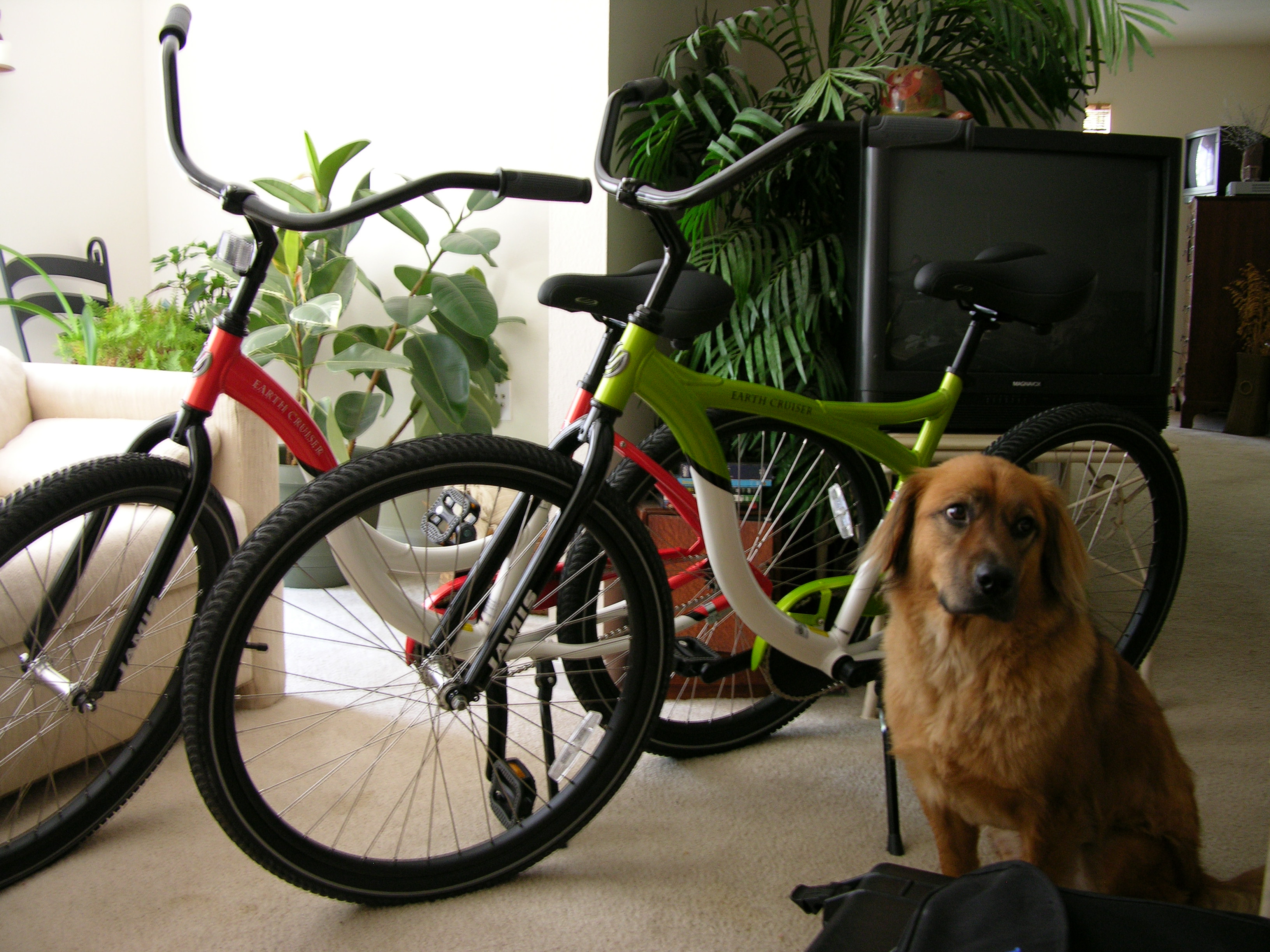
We got new bikes this week for Folly Beach and downtown Charleston.
-
Miranda July
Miranda July is quite a piece of work. She knows how to make a good film. We watched the Me and You and Everyone you know film over the weekend. It’s stellar. www.meandyoumovie.com/
-
Intellectual Rights
just some resources for intellectual property
ASCAP
Berkman Center at Harvard
ChillingEffects.org – Great resource for case studies
by topic
anyway… this one is funny..Kelloggs Poops on Evilpoptarts.com
June 5, 2006
Sender Information:
Kellogg Company
Sent by: [Private]
[Private]
Battle Creek, MI, 49016, USARecipient Information:
[Private]
evilpoptarts.com
San Francisco, CA, 94117, USASent via: email, postal mail
Re: RE: Domain Name “evilpoptarts.com”June 5, 2006
[private]
San Francisco, CA 94117Re: Domain Name “evilpoptarts.com”
Dear [private]:
Kellogg Company has recently been alerted to the existence of the domain name evilpoptarts.com which is registered in your name. Your registration of this domain name inhibits Kellogg Company’s legitimate uses of its POP-TARTS® trademarks and the corresponding domain names. Accordingly, Kellogg hereby demands that you immediately cease and desist from continuing the use of this domain name and that it be transferred to Kellogg. Your use of this domain name constitutes a violation of Federal Trademark Laws and a misappropriation of our company’s intellectual property.
Please note that Kellogg Company is the owner of the following federally registered trademarks: POP-TARTS® Reg. Nos. 791514 and 1671971; POP-TARTS PASTRY SWIRLS® Reg. No. 2358511; and POP-TARTS SNAK-STIX® Reg. No. 2498744. These trademarks are registered with the United States Patent and Trademark Office and protected under the provisions of the Trademark Act (15 USC 1051 et. seq.) as well as the Federal Trademark Dilution Act of 1995 (15 USC 1125(c)) and federal copyright law.
Kellogg Company has expended vast sums of money throughout the United States and the world in the advertising and protection of its famous marks. The POP-TARTS® name and marks have become highly distinctive properties of Kellogg Company. These trademarks create in the mind of the public, an instant identification with the high quality products and services of Kellogg Company. The distinctive wording POP-TARTS® is used by Kellogg in various contexts such as in connection with the Kellogg licensing program, including use on clothing and advertisements for various Kellogg products and services. It is therefore important to us to maintain the validity of this mark and to assure that it is not infringed upon or misused by unauthorized third parties.
Please be advised that, unless you cease and desist any further use of the evilpoptarts.com domain name and cooperate in the transfer of the domain name to Kellogg Company, Kellogg reserves the right to pursue all of its legal remedies for both money damages and injunction relief under state and federal law, including the Anticybersquatting Consumer Protection Act of 1999.
If you have any questions, please contact, or have your attorney contact, [private], Trademark/Licensing Attorney, Kellogg Company as soon as possible by telephone at (269)[private] or by email to [private] in order to discuss this matter.
Sincerely,
[private]
Paralegal – Trademarks/lvd
thermometer
Having a Bad Hair Day? Customer tries to get even with Bosley Medical.Ameet Patel, DePaul University College of Law Technology/Intellectual Property Clinic, September 14, 2005
Abstract: In a domain name dispute, the Ninth Circuit found that the use of another’s trademark as part of a domain name for a noncommercial gripe site does not constitute trademark infringement or dilution under the Lanham Act. However, the court remanded the matter back to the district court to determine whether in registering his domain name the defendant had a “bad faith intent to profit” from plaintiff’s trademark which would allow recovery under the Anticybersquatting Consumer Protection Act (ACPA).
In Bosley Medical Institute v. Kremer, the defendant, Michael Kremer (Kremer), was dissatisfied with the hair restoration service provided by the plaintiff, Bosley Medical Institute (Bosley). As a result, Kremer launched a website under the domain name BosleyMedical.com that was highly critical of Bosley and its services. Bosley, which owns the trademark to the name “Bosley Medical,” brought suit alleging trademark infringement and dilution under the Lanham Act, as well as a claim under the Anticybersquatting Consumer Protection Act (ACPA).
Athough Kremer’s website contained information critical of Bosley, it did not offer for sale any goods or services, nor contain any commercial advertising. The website had no links to Bosley’s competitors but did have a link to a newsgroup chat room, which in turn contained links to competitors and to Public Citizen-the organization representing Kremer in the case.
In rejecting Bosley’s trademark claims, the District Court concluded that Bosley failed to show that Kremer’s website was a “use in commerce” as required by the Lanham Act. On appeal, the Ninth Circuit stated that “use in commerce” was merely a jurisdictional predicate and the proper inquiry was whether Kremer’s website was “in connection with a sale of goods or services,” in other words, “commercial use.” Bosley advanced three arguments to support its assertion that Kremer’s website was in fact a commercial use.
First, Bosley argued that although the website itself did not include advertising, it contained a link to a newsgroup chat room, which in turned contained links to advertisements from Bosley’s competitors. The court rejected this argument because the linking to other sites was “too attenuated” to render Kremer’s website commercial. The court also held that Kremer’s identification of his lawyers with a link did not constitute commercial use.
Second, Bosley argued that Kremer planned to profit from registering the domain name by extorting money from Bosley and thereby making his use of the domain name commercial. The court rejected this argument because the record contained no evidence that Kremer was trying to sell the domain name itself.
Finally, Bosley argued that Kremer’s website was a commercial use because using Bosley’s trademark as its domain name prevented users from obtaining Bosley’s goods or services. In support of this, Bosley relied on the Fourth Circuit’s decision in People for the Ethical Treatment of Animals v. Doughney. In that case, the Fourth Circuit held that a parody site that criticized PETA satisfied the commercial use requirement because it prevented users from obtaining PETA’s goods or services. Although the court distinguished PETA from the present case – the website in PETA directly linked to other commercial sites – it disagreed with the Fourth Circuit’s rationale in determining whether a website is a commerical use. According to the court, such an expansive reading of the commercial use requirement would place all consumer commentary sites under the reach of the Lanham Act. Instead, the court stated that the appropriate inquiry was whether the defendant offered competing goods or services. The court concluded that no customer would mistakenly purchase a hair replacement service from Kremer under the belief that the service was offered by Bosley. As such, the court concluded that Bosley failed to prove that Kremer’s website satisfied the commercial use requirement under the Lanham Act.
Although the court rejected Bosley’s claims under the Lanham Act, it did leave open the possibility that Bosley could pursue a claim under the ACPA. The court reversed the District Court’s holding that Kremer did not violate the ACPA because his website was noncommercial. The Ninth Circuit clarified that the ACPA does not have a commercial use requirement, and stated that the district court should have decided the issue based on whether Kremer had a “bad faith intent to profit” from Bosley’s trademark. The court stated that allowing a defendant to register a domain name in bad faith but get around the statute by making noncommercial use of the trademark would defeat the purpose of the ACPA. Accordingly, the court concluded that Bosley was entitled to discovery on whether Kremer had a bad faith intent to profit from the use of the domain name.
-
wiki leaks
I had read this story on Friday in the NYtimes and after following up on it i can tell you some interesting tidbits about it’s legal implications on the web. Wikileaks is going to continue to stay in the headlines. I went digging through the material available there and it’s pretty heavy.
-
Sam Beam
A mutual friend sent me this video in an email. I’ll say this… Sam is talented and always has been or at least since I’ve known him. This is quite the departure from the New Order he espoused in high school. I like it though. It’s soft and sincere. Evidently it’s on a movie soundtrack and I think he’s getting some recogition. Go Sam!
-
Bach – Glenn Gould
-
Moving 150 Domains
Is a pain in the ass. I’m moving the domain registration and the hosting.
-
McClellanville SC
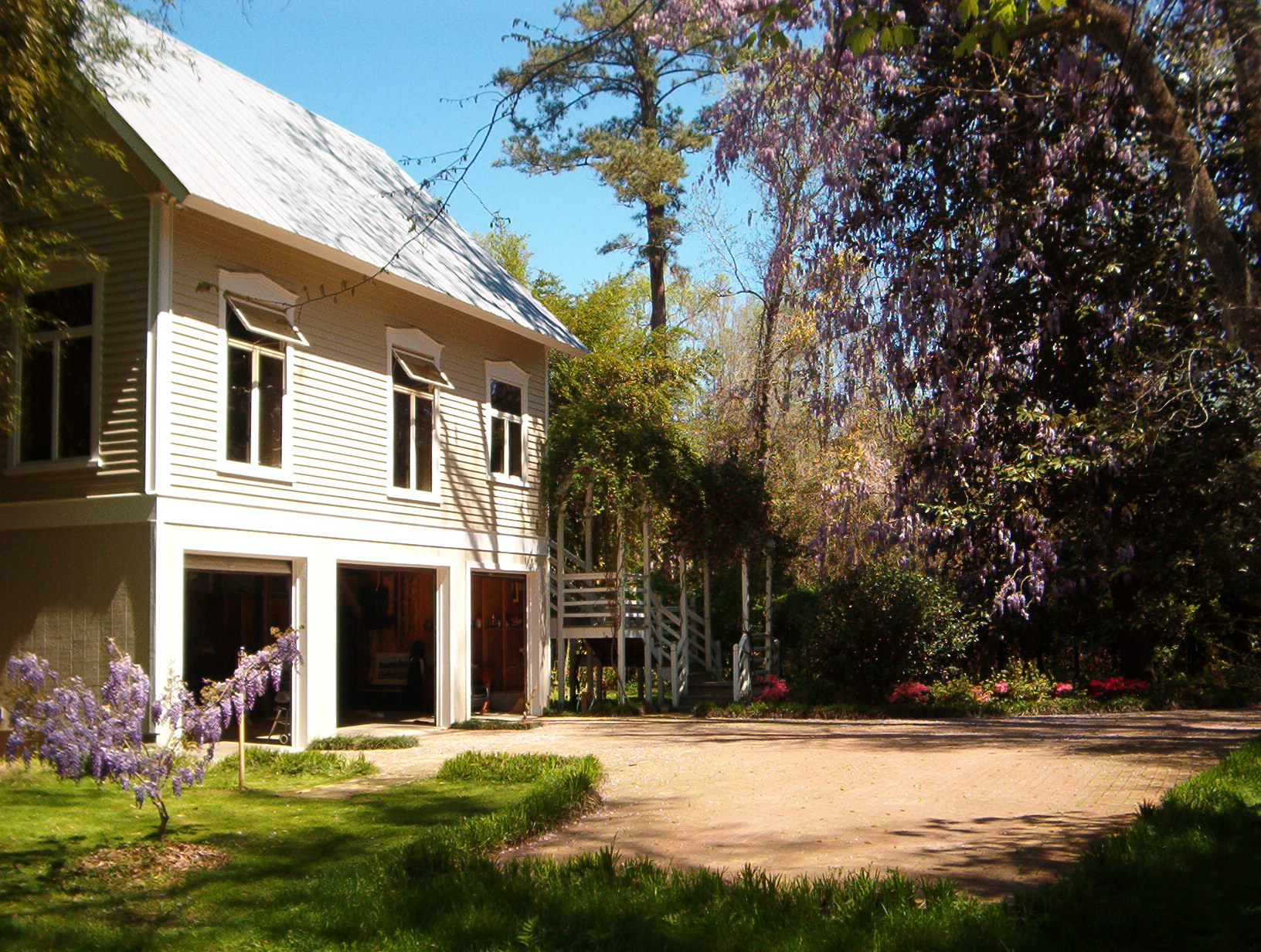
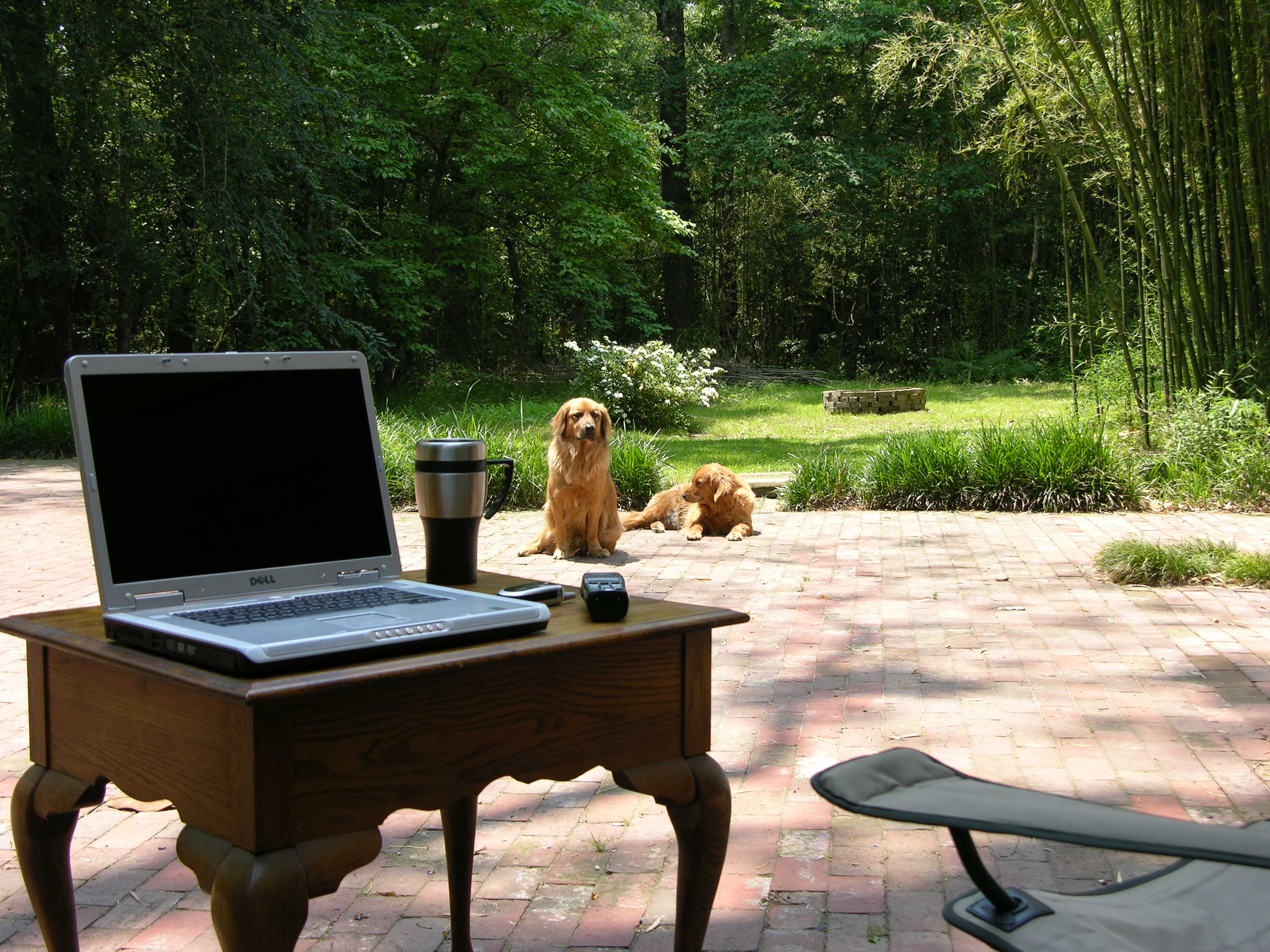
I lived in McClellanville for a couple of years now. I moved from Mt. Pleasant after buying a house up this way. As you can see, my office really suits my style. I think the dogs like it too.
-
Second Life
My brother and I have been dabbling around with Second Life. He’s a big fan of using the Kool-Aid guy avatar.
Second Life Second life is an online community… like myspace, with a virtual world built by users. This game? is no joke for big companies including Wells Fargo, Amex, Walmart, Amazon etc.. Here are some articles..
www.businessweek.com
www.cbsnews.com
wikipedia
www.wired.com
making moneyMaking a Living in Second Life
By Kathleen Craig| Also by this reporter
02:00 AM Feb, 08, 2006Jennifer Grinnell, Michigan furniture delivery dispatcher turned fashion designer in cyber space, never imagined that she could make a living in a video game.
Grinnell’s shop, Mischief, is in Second Life, a virtual world whose users are responsible for creating all content. Grinnell’s digital clothing and “skins” allow users to change the appearance of their avatars — their online representations — beyond their wildest Barbie dress-up dreams.
Within a month, Grinnell was making more in Second Life than in her real-world job as a dispatcher. And after three months she realized she could quit her day job altogether.
Now Second Life is her primary source of income, and Grinnell, whose avatar answers to the name Janie Marlowe, claims she earns more than four times her previous salary.
Grinnell isn’t alone. Artists and designers, landowners and currency speculators, are turning the virtual environment of Second Life into a real-world profit center.
“It’s not just a game anymore,” said online artisan Kimberly Rufer-Bach. “There are businesses, nonprofits and universities” taking advantage of the online world.
With users now numbering over 130,000, game-maker Linden Lab estimates that nearly $5 million dollars, or about $38 per person, was exchanged between players in January 2006 alone. Working in Second Life is “the same as working in London and sending money home to pay the rent for your spouse,” said company CEO Philip Rosedale.
Just ask Rufer-Bach, known in Second Life as Kim Anubus, who works full time making virtual objects for real-life organizations. In a recent contract with the UC Davis Medical Center, Rufer-Bach created virtual clinics in Second Life to train emergency workers who might be called upon to rapidly set up medical facilities in a national crisis. The work is funded by the Centers for Disease Control. “In the event of a biological attack ? the CDC have to set up emergency 12-hour push sites, to distribute antibiotics,” said Rufer-Bach.
To create the most realistic simulation possible, Rufer-Bach crafted about 80 distinct objects, “from chairs (to) a forklift, plumbing, wiring,” she said. The end result is a training environment that’s not only lifelike, but relatively inexpensive. “There are substantial advantages to doing this training in the virtual world,” said UC Davis professor Peter Yellowlees. For one thing, it’s “incredibly cheaper.”
Of course, most of the business opportunities in Second Life don’t involve anything as weighty as medical training. The game has a significant market in specialized avatars: People pay as much as 2,200 in-game “Linden dollars,” or just over $8, for stock avatars — with custom work commanding prices that can go much higher. Rufer-Bach ordered a special avatar for her mother, “a knee-high lavender warthog, with a tiara and wings and a big fat spleef with smoke effects.”
The game world’s mixture of fancy and serious business can lead to some incongruous scenes. “We joke that you just don’t show up at a business meeting as a mermaid,” said Rufer-Bach. “One guy is a furry, with an animal head. Another’s a ball of glowing fuzz. There’s a giant two-story robot transformer.”
One they’ve perfected their look, Second Life immigrants who want to build virtual homes often purchase or rent land from entrepreneurs like Tony De Louise, from Long Island, New York, who gave up the meatspace rat race to become an online landlord. “I’ve worked two to three jobs most of my life,” said De Louise. Now, “instead of coming home at 10:30 at night, I’m home and can help my wife put our new baby to bed.”
De Louise and business partner Alice McKeon own d’Alliez Island Rentals, and now lease land on a chain of in-world islands they own. They pay Linden Labs $1,250 for each island, plus a $195 monthly maintenance fee. Renters in turn pay from $15 to $75 for average-size land parcels.
“We have three purely residential (islands), one purely commercial,” said De Louise, whose in-world name is Tony Beckett. “Two are for furries,” who prefer animal-like avatars.
The landowners act as benign dictators of their property, making sure the islands are calm and protected, and helping renters get started building their own homes or businesses.