-
Google Radio and DMarc Broadcasting
It looks like Google will try handle some radio advertising.
TechCrunch
ZDNet.com
News.com
Slashdot.orgGoogle is allowing some of its existing online marketers to use its automated advertising system to broadcast ads on radio stations around the United States, the company said on Thursday.
The beta test of Google Audio Ads is the result of the integration of technology from Google’s acquisition of radio advertising company dMarc Broadcasting nearly a year ago.
The test is limited to just over 20 Google AdWords customers and more than 730 stations, including XM Satellite radio, said Ryan Steelberg, head of radio operations for Google and a co-founder of dMarc.
The radio ads are running in more than 260 metropolitan markets, covering about 87 percent of the country. The company is hiring “scores” of radio sales people in major markets and is offering them 50% above prevailing salaries. From the article: “Google spokesman Michael Mayzel said this week that the company will begin a public test of Google Audio Ads by the end of the year. Advertisers will be able to go online and sign up for targeted radio ads using the same AdWords system they use to buy Web search ads. It made a clear move into radio in January when it agreed to pay more than $1 billion, depending on performance, for dMarc Broadcasting Inc., which connects advertisers to radio stations through an automated advertising system. It’s all part of what Google Chief Executive Eric Schmidt has said is an investment in radio advertising that could grow over time to include up to 1,000 Google employees not just in ad sales, but also in engineering and operations.”
Google’s ambitious foray into radio advertisements may be significantly delayed, says RBC Capital Markets analyst Jordan Rohan. The problem? Google may not have access to enough radio airtime for advertisers to test the product.We first wrote about Google Audio ads a week ago when competitor Voices.com was saying flat out that Google copied part of their product. Google plans to handle audio ads for customers from soup to nuts: assistance with ad creation, the ability to bid on radio spots, and target ads by geography, station type, listener demographics and time of day.
But none of this is useful if Google isn’t able to get access to advertising inventory. ‘We believe a critical mass of advertisers is interested in testing the platform’, Rohan said. ‘However, there is simply not enough radio inventory in the Google Audio system (yet) to enable buyers to run campaigns.’
Google may be working on a deal with CBS Radio to get access to more ad space.
-
Swivel Zillow
I just like the ring that title has to it…
Swivel ( https://techcrunch.com/2006/12/05/swivel-to-launch-this-week-communitize-your-data/ ) looks really clever. It’ll allow you to upload any data and compare it visually. They’re going for the free public/paid private model. I’m really interested to see what becomes of it.
Zillow ( https://techcrunch.com/2006/12/06/zillow-knows-that-everyone-has-a-price/ ) is right on time and is growing fast. Having spent a little time in the online real estate arena, I’m fairly confident that their model will work well.
I also noticed this week that Arbitron and Nielson are trying to get a foothold into the web analytics business moving over from the more traditional advertising mediums. Nielson Rating / Arbitron Multimedia
-
IPTV
I keep reading articles about Internet Protocol Television. With Coca Cola teaming up with Youtube for holiday greetings… you should read these Decenber 7th Reuters / Reuters – Dec 9th And here’s a bit I clipped from another article:
How TV Will Become the Ultimate Open Content Platform
POSTED: Thursday, December 07, 2006
FROM BLOG: Micro Persuasion – Steve Rubel explores how new technologies are transforming marketing, media and public relations.Since the dawn of the medium in the 1950s, big media has had a stranglehold over what you watch on your TV. However, that’s all about to change. A perfect storm is brewing. A-la-carte programming, branded entertainment and peer-created content are all coming to your TV in glorious high definition – all brought to you by the letters IPTV.
This is going to be one of the most important media trends over the next five years. The rapid pace of change will not only turn TV into an open content platform, but it will radically shift how advertising dollars are allocated and how the entire ad industry operates.
Despite the ever creeping presence of the Internet into every part of our digital lives, TV is still hanging on strong. According to a report published by Jupiter Resarch earlier this year, the two are neck and neck as measured in time spent – though the Net will eclipse TV soon. This will only accelerate the evolution of TV into an open content platform that more closely emulates the Net.
My own feeling is that both TV and the Internet will remain popular. One will not replace the other. From a pure viewing experience, big screen TVs clearly provide a more superior experience to watching video on a computer or a mobile device – particularly with the rise of HDTV. However, more and more TVs are going to connect to the Internet directly via specialized devices like Apple’s ITV in addition to your cable or satellite box. With this, your TV open up to thousands of content creators, pro and amateur.
As we look ahead – say three years from now – TV viewing will become even more fragmented. But make no mistake, IPTV is going to make television even more relevant in our lives than it is today.
The open TV platform will comprise of four key sources of content: network programming via your cable/satellite provider, a-la-carte shows sold directly to you by networks/studios, branded entertainment developed by major marketers and consumer generated content piped in via RSS. Let’s take a closer look at the prospects for each.
Network Programming – The TV networks, be they ABC, NBC, CBS, etc. or more specialized ones like ESPN and The Food Network, will continue to be a force in a more open, IPTV world. However, they will face increased competition from the very advertisers they covet as marketers produce their own programming and go direct. The nets will need to buddy up with advertisers to co-create branded entertainment programming to keep them in their fold.
A La Carte TV – Pay as you go TV platforms like Apple’s iTunes and Microsoft’s Xbox Live (an Edelman client) right now are experimental. Consumers like the option to time and place shift content and catch up on shows they forgot to DVR. However, a la carte TV will evolve dramatically in the months and years ahead. Studios will sell their shows to you without the networks. At the same time, the nets will use IPTV to test pilots – for free – in an effort to find the next big mega hit to put on the schedule.
Branded Entertainment – A lot of branded entertainment programming lives online right now. However, as TVs get a direct pipeline to the Internet, advertisers will invest heavily to create their own programming and bypass media. The institution with the most to lose or gain here (depending on how you look at it) are the ad agencies. They will have to transform themselves into hip, content shops that perhaps steal refugees from the TV networks and studios.
Peer Created Content – As we’ve seen time and again, we love to watch people like us. This is not just all about YouTube. It dates back to Candid Camera and America’s Funniest Home Videos. The trend is evergreen. However, RSS feeds are going to find their way onto your TV set either from your cable/satellite provider or via IP-connected devices like Apple’s ITV, Xbox, Slingbox or TiVo. The user won’t know that the RSS is even there. They will be able to browse through thousands of shows created by individuals and subscribe to them on their TVs. Many of these will be ad supported. Most will be free. Some that are more successful will require micro payments to view.
So to sum up, TV is going to be fine, thank you. But it will look nothing like it does today and it will be open to all of us.
-
Million Dollar Homepage
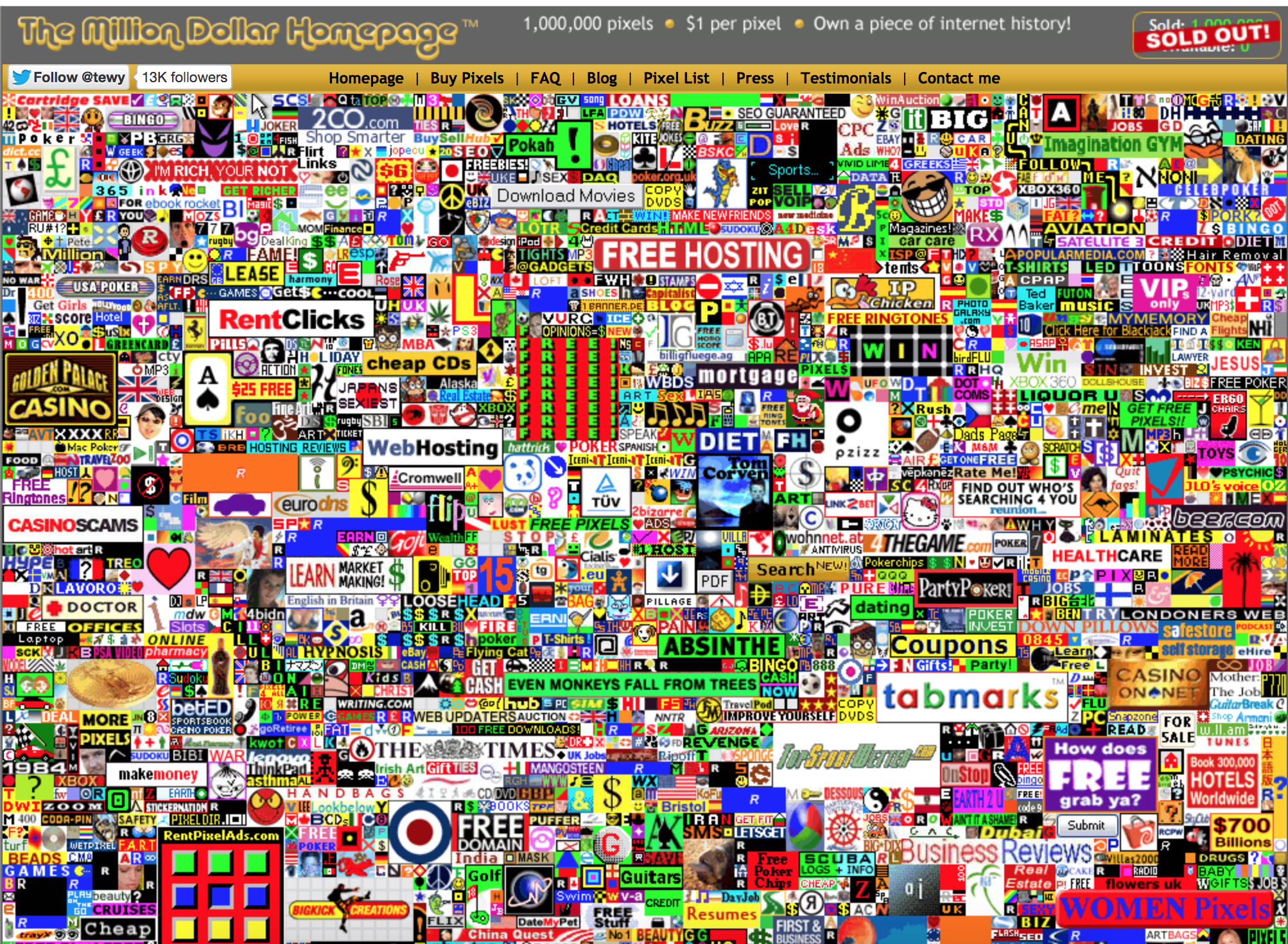
I like to watch the movers and shakers page on Alexa.com It’s creative pop driven culture at it’s best. I found a really good one this morning. This guy, in trying to finance his college raises a million dollars in two months by selling ad space on one single webpage. It’s up 310% to a Weekly Traffic Rank: 2,695 (was 12,730)
You can take a look at www.milliondollarhomepage.com
-
Side Dish of IE 7
My Microsoft Outlook, which my brother jinxed when he asked me why I was still using it, died on me. Of course the Window’s diagnostic was a Microsoft Office upgrade which let me to Internet Explorer 7. I’ll say this about IE7…. they did good with more support for css, native XMLHTTP stack, alpha transparencies in png’s, the font smoothing mechanism is nice, the full screen browsing is good… the tabs are good, the security measures are up… it looks like a winner for everyone involved and I had just taken a bunch of jabs at Microsoft in my previous post. I might be jinxing myself with it comes to Microsoft??
-
Microsoft Expression
(REDMOND, Wash. – Dec 4, 2006) Microsoft Corp. today announced significant product line enhancements along with pricing and availability of the Microsoft Expression Studio for creative professionals.
…. Microsoft FrontPage was a good starting step, but looking back on it now, it’s crappy and I’m pretty sure Expression will be just one step up from that with a few more widgets, bells, and whistles.
-
Satire is the Copyright Loophole
It’s Weird Al Yankovich again.
-
Berkeley Webcast
http://webcast.berkeley.edu/ is right on. They offer videos of their classes and courses. Seems like every university should be doing this.
-
Digital TV
CBS News site / Advertising Age Article
60 minutes aired a piece on Netflix and now I’m streaming it on my website and watching it again on my tv straight from CBS.com The CEO of Netflix revealed their subscription download service premier in January and was most likely there to drum up support. CBS recently partnered with youtube and here’s an article on how they attribute it to an upswing in their ratings. The show elluded to the industry trend of providing movies online and its effect on even the recently spawned Netflix. The tv industry is gearing up for these changes in a manner like we’ve seen here in local markets, where the news cast are running four hours of primetime. PBS.org provides all of their premium show for free downloads. The current issue of Wired magazine features an insightful article that wonders were that 70 billion in television advertising revenue will go. I can say this…. 90% of the time, my television screen and home stereo is under the control of my computer now. I watch what I want, when i want to. They even release the nightly news programs online now with a couple hour delay. The embedded video on webpages can be viewed on my tv. The windows media player sucks for large format, but another great feature is that quicktime, real player and windows media automatically default to full screen on my television while playing on the laptop. anyhow.. any media can be viewed on my tv that is embedded into the pages. While simultaneously reading the pages on my laptop. Sony is selling Location these location free consoles that much like the slingbox will allow you to access your cable connection from any broadband connection. So much like the popularity of the TIVO, why watch commercials and other crap.. just watch what you want, when you want, where you want and run your home tv and stereo as a remote monitor for your computer all for $199.. they’ll be a winner provided they’re Vista capable. So my whole point is that the media convergance of tv and the internet is already happening
Ad-supported video continues to gain momentum online. Google has teamed up with Viacom to provide video clips to websites that are part of Google’s AdSense Network. Viacom is the parent company to MTV, VH1, CBS and a number of other premium networks. The deal will be positioned as a revenue generator for Google, Viacom, and AdSense partners. All three will split revenues derived from the tie-in of advertising and content.
It will work like this: publishers (bloggers, big media, etc.) can elect to embed shows such as MTV’s “Laguna Beach” or Nickelodeon’s “SpongeBob Squarepants” on their own web pages in a manner similar to how YouTube supports embedded video. The clips themselves will contain advertising sold not by Google, but by the networks’ own ad sales teams. Those networks will share a portion of this revenue with Google, which will in turn share a portion of that revenue with the publishers themselves.
Another current article from Ad Age about the future of interactive tv. right here you can view all of the major networks programming notes including new broadband channels. American Advertising Federation WASHINGTON, D.C., November 14, 2006 – A study conducted for the American Advertising Federation (AAF) reveals that advertising leaders have more than embraced new media as part of successful advertising strategies. Most leading ad executives expect a significant portion of broadcast and cable TV ad dollars to shift to online video by 2010, with 33 percent predicting that switch will be between 10 and 19 percent. In addition, 2007 budgets for online advertising are expected to rise by an average of 42 percent over 2006. As to the challenge of integrating traditional with online media, broadcast TV is seen as offering the “most innovative” integration with online media, while magazines are seen as “most effective” for driving consumers online.By act of Congress, conventional analog television is scheduled to shut down on February 17, 2009. From that day forward, all free, over-the-air broadcasting will be digital.
-
Ruby, MySQL, Darwin, Cygwin, lighttpd, Putty, Subversion, Ajax, etc…
Update: 7/07/2020 – I’m unsure as to why I used to posts things like this. I think I just used my website as a bookmarking tool on occasion. I imagine I was in the process of learning these at the time. I leave the posts up anyway because it’s a snapshot of where I was in November of 2006. Looks like I was just getting into Ruby on Rails. I leave the original links in place even if they’re dead. The Way Back Machine has some of them archived.
ruby on rails
Pragmatic Programmer
ruby
mysql
mysql again
cygwin
ajax
State of Rails
Putty
blog engine in 15 min on rails
ruby for java kids