Feed

  • Twitter

    I logged in the first time soon after it started in 2007. I did my ten years and then mostly logged off by 2017. I’m not likely to start using it again regularly although I still use it occasionally as a people bookmarking service of sorts. I logged in last week to get an ‘archive’ of all of my data and publish it elsewhere1,2.  I tweeted 828 times and based on the IDs in the data, I’m guessing that I was the 950,535th person to ever tweet. The process felt achingly familiar3. I’ve had some discussions with others about it recently and it reminds me to think about how I use the web. Per the course… I like to flush it out, write it down, and publish it so I can send a link instead of hashing it out in an email or text thread.

    Twitter was built as a MicroBlogging service. Microblogging as a type of broadcast medium was the forerunner to social networking platforms. Social networking existed from the moment the first network computer connections were made. Twitter had a good name and was the best breed of something not unique amongst the landscape at the time. The fundamentals of Twitter already existed elsewhere. The Twitter idea originated from Odeo4,5, a podcasting company. It was just a means of having an SMS group chat.  Evan Williams created Blogger which was sold to Google and was the basis of the ideas behind both podcasting and blogging. Before Twitter, social media meant connecting with others online primarily through email and RSS, both of which could be read from the same client and in a browser. Some folks worked out unique ways to notify others via email for pingbacks and trackbacks6. I was a fan of Friendfeed because it supported pulling feeds from various sources. Facebook acquired it for $15 million and shut it down7.  Similarly, Pump.io, StatusNet, and identi.ca were using the open-source Activity Streams format which was a precursor to the ‘Fediverse’ or federated social network terms tossed around today. 

    Inter-Net-work….the web was inherently social long before the media part. In Silicon Valley’s race to capitalize, proprietary methodologies were created because open standards hinder income potential. Even the data archive I got from Twitter last week isn’t exactly portable. The WC3, who sets the standards has recommended Web Mentions, Activity Streams, and Activity Pub9 standards which is the protocol that makes Mastodon federated. I migrated most of my Twitter follows over to Mastadon while I was at it last week. Watching the other platforms pivot to gain new users is amusing. Substack has added ‘mentions’, ’cross-posts’, and ‘best seller’ badges10. Tumblr rolled out a $7 badge and the owner insisted they would be implementing the activitypub specification which I noted appropriately11. I’m sure folks will figure out a way to spam those protocols too as long as there is a way to profit from them. Twitter turned to bots after it gained popularity and the account APIs were introduced. The bot, spam, link farms, etc were online long before Twitter too.

    Elon Musk recently tweeted “Vox Populi, Vox Dei” likely in reference to his surveys on reinstating previously banned accounts. It translates to the “Voice of the People is the Voice of God”,  but the full context of the most cited reference to that term is:

    Nec audiendi qui solent dicere, Vox populi, vox Dei, quum tumultuositas vulgi semper insaniae proxima sit.  “ And those people should not be listened to who keep saying the voice of the people is the voice of God since the riotousness of the crowd is always very close to madness. 

    ~ Alcuin in his letters to Charlamagne Epistle 127 in 760AD12.

    The riotousness of the crowd is Twitter. And Twitter is just a bellwether for the internet as a whole as we adapt to new communications mediums. Those first couple of years were just techie types tweeting because those were most of the same folks with websites.  Then came the journalists, media, celebrities, publishers, and internet celebrities. Then everyone’s uncle had it installed on their phone.  When those other folks started rambling on about their other interests, I lost interest. And then they started to monetize it all with adverts, tracking users across the web, and rewriting shared URLs so they could track those too.  The most retweeted thing ever was a pyramid scheme offering a reward for retweets. The web was already decentralized and will likely always be outside some platforms’ walled gardens. I just hope that the efforts to improve the open standards aren’t sabotaged by private interests.

    I’m sure in the coming year we’ll end up hearing a lot more on free speech and social media. I have a very simple minded approach to it which I wrote about pretty extensively in my article on Section 23013. I think that you’re welcome to espouse your opinions, ideas, or theories however you’d like but not entirely without consequence if they are damanging to others. I think that the main product of social media platforms, aside from usability, is sorting and moderating that information so that it’s vaulable to it’s end users. A platform like Twitter is a private company and can make itself reponsible for moderation however it best see’s fit to it’s own business model. And likewise, I can excersize my own liberty to not pay it any attention.

    I’d use social media again if I had something to promote and I suppose I’m lucky not to have the need. Former Twitter CEO Evan Williams apologized saying he was “wrong to think that an open platform where people could speak freely would make the world a better place”.  I wouldn’t completely agree with him on that because I believe there have been some good things gained through social networking platforms.  I read an essay recently fed to me, not via social media but my handy dandy good ole’ fashion hosted RSS reader…  entitled A Tweet Before Dying that said “What then? We’ll all move over to some Twitter replacement like Mastodon, hundreds of millions of us, and ruin that too? Sigh.”13. Other than echoing my sentiments here, whatever happens with Twitter means very little to me because I choose to rely not on the platform itself but on the interoperable standards of the internet which were social from the get go. 

    2022/12/03 Update:

    Right on Cue… Matt Taibbi, the investigative journalist published a series of tweets he’s calling the Twitter Files15 yesterday afternoon looking into the content moderation efforts of Twitter during the last election. Main takeaway for me was the fact that, imagine this… people are sending emails around requesting removals and questioning various policies. Sometimes just having an audience has it’s own consequences.

    2025/11/15 Update:

    The thing is… all this new reporting on foreign spam accounts seems so obvious to me, I can’t even really understand how it’s news other than the fact that they added the ‘about this account’ features showing country of origin16. The new reporting did kinda touch on something I hinted at here and that America’s Polarization Has Become the World’s Side Hustle17. Perhaps I’ll log in again and leave this as my only ‘tweet’ since I previously deleted all of the others… na, ole Space Karen isn’t getting any eyeballs from me.


    1. @windhamdavid tweets – https://davidwindham.com/til/lists/tweets 
    2. @windhamdavid follows – https://davidwindham.com/til/lists/people#i-follow-on-twitter
    3. Windham, D. 2020. Dirty Algorithmhttps://davidwindham.com/dirty-algorithm/
    4. Odeo – https://en.wikipedia.org/wiki/Odeo
    5. Twitter History – https://en.wikipedia.org/wiki/Twitter#History 
    6. Pingback https://en.wikipedia.org/wiki/Pingback
    7. FriendFeed – https://en.wikipedia.org/wiki/FriendFeed 
    8. Silicon Valley – S3E10 – https://en.wikipedia.org/wiki/Silicon_Valley_(TV_series)
    9. W3C Social Web Protocols- https://www.w3.org/TR/social-web-protocols/ 
    10. Substack – https://on.substack.com/p/introducing-mentions-and-cross-posts
    11. Tumblr –https://windhamdavid.tumblr.com/
    12. Alcuin – https://en.wikipedia.org/wiki/Alcuin
    13. Windham, D. 2021. Section 230https://davidwindham.com/section-230/
    14. Ford, P. 2022. A Tweet Before Dying – https://www.wired.com/story/tweet-dying-revolutionary-internet/
    15. Taibbi, M. 2022. The Twitter Files https://twitter.com/mtaibbi/status/1598822959866683394
    16. Elon Musk’s Worthless, Poisoned Hall of Mirrorshttps://www.theatlantic.com/technology/2025/11/x-about-this-account/685042/
    17. America’s Polarization Has Become the World’s Side Hustlehttps://www.404media.co/americas-polarization-has-become-the-worlds-side-hustle
  • David Byrne

    I went to see David Byrne in Asheville a couple weeks ago. We were in the first rows and the audience started following the performers dance moves. It was like being in some sorta intimate line dance with the band. It was stellar. Watching him perform is more akin to watching a preacher than a rock musician. I’ve had a long held fascination with David Byrne and I think it began in August of 1981 when MTV first went on the air and I saw this video.

    I would have been just under 10 years old the first time I saw the video, but I remember quite vividly the debut of MTV on our console television in the living room. MTV aired a bunch of the same videos1 over and over, but none of them grabbed my attention the way Once In A Lifetime by the Talking Heads2 did. In retrospect, I believe the innovative use of film editing was just the product of the art school background of the Talking Heads band members. At that age, I didn’t really understand the meaning of the lyrics and it was only the motion that intrigued me. Regardless, the song reappeared in a 1989 film entitled Down and Out In Beverly Hills3, which gave me a bit of insight into the meaning of it. The theme of the film kinda nailed the existential crisis of the song lyrics. About that same time (1989) I owned exactly two concert films on VHS: The Song Remains the Same by Led Zepplin and Stop Making Sense by the Talking Heads4. Both of which are two of my all time favorite concert films. I bought up about every Talking Heads and David Byrne CDs I could get my hands on. And I played them non-stop. I had a couple friends who also enjoyed them, but they were few and far between.

    Skip ahead fifteen years or so, when I met my wife in college. Two things really stood out about our first date from my other gal pals. The first is that she had a really good sense of humor, not just the giggle type, but the dark and cynical gut rolling humor I like. The second thing is that she really liked the David Byrne and Talking Heads. It wasn’t just the ‘oh yeah, they’re cool’ type of like. She knew all of the lyrics to most of the songs and understood them. The first birthday gift I ever bought her was a talking heads CD box set. We played that thing out on every trip we took. I’ve since read How Music Works6 and followed about every recording project, film, or book he’s been involved with. I’m also particularly fond of his internet radio station7 because of the way he curates the playlists. I can’t say there is anything he’s created that I don’t like. I am particularly fond of a couple though… the film True Stories, Look Into the Eyeball, and Uh-Oh. I also really like the soundtrack to The Last Emperor and it was nice seeing him play himself on the Simpsons Dude, Where’s My Ranch? and in This Must Be the Place.

    Neither of us have ever seen David Byrne in concert. I bought the tickets as soon as they went on sale and put us in the second row. As with what has been noted the style of that original video in that he studied archive footage of “preachers, evangelists, people in trances, African tribes, Japanese religious sects” to see how he could incorporate them into his performance… the live performance we watched wasn’t too far off. The way he engaged the audience wasn’t that of a rock star, but of an evangelist. Because the set design was so simple and the accompanying band members engaged in a rehearsed synchronized dance routine, the first ten rows of the auditorium were completely engaged in the performance. Him and his crew were working hard breaking a sweat, and had obviously spent countless hours rehearsing the material and choreography. Like I said… it was top notch. We already knew the lyrics to the new album so we listened to the Imelda Marcos inspired musical Here Lies Love5 written by Byrne on the way up, while Ginny researched the Marcos’ real life. On the way back we listened to Brian Eno. I’d give the American Utopia concert a 10/10. And I give David a 10/10 on being an artist and a decent human being.

    Here’s the setlist for the show (Asheville, NC – May 8th, 2018):
    Here – Lazy- I Zimbra (Talking Heads) – Slippery People (Talking Heads) – I Should Watch TV (David Byrne & St. Vincent) – Dog’s Mind – Everybody’s Coming to My House – This Must Be the Place (Naive Melody) (Talking Heads) – Once In a Lifetime (Talking Heads) – Doing the Right Thing – Toe Jam (Brighton Port Authority) – Born Under Punches (The Heat Goes On)(Talking Heads) – I Dance Like This – Bullet – Every Day Is a Miracle – Like Humans Do – Blind (Talking Heads) – Burning Down the House (Talking Heads) – Encore: Dancing Together – The Great Curve (Talking Heads) – Hell You Talmbout (Janelle Monáe)


    25/12/04 Update: We saw David again last night in Atlanta for the Who Is the Sky? tour8. The thing is I’ve seen a lot of concerts in my lifetime and it’s definitely different. David takes a bunch of highly trained dancers, musicians, and vocalists and puts em through their paces in a thematic visually stunning choreographed set. He gave em what they wanted on this tour, yet the set list of songs somehow still felt like a tightly planned concept album. It’s really about him as an artist. It’s kinda hard to explain, but it’s like he’s floating up above it to steal a line from his song. He’s not rooted in any physical place or timeline even though several of the songs have very physical references. The lyricism is timeless and abstract – he blended a setlist that spans almost fifty years. Here’s the setlist:

    • Heaven ( Fear of Music )
    • Everybody Laughs ( Who Is the Sky? )
    • And She Was ( Little Creatures )
    • Strange Overtones (Brian Eno – Everything That Happens Will Happen Today )
    • Houses in Motion ( Remain in Light )
    • T Shirt ( Who Is the Sky? )
    • (Nothing but) Flowers ( Naked )
    • This Must Be the Place (Naive Melody) ( Speaking in Tongues )
    • What Is the Reason for It? ( Who Is the Sky? )
    • Like Humans Do ( Look into the Eyeball )
    • Don’t Be Like That ( Who Is the Sky? )
    • Independence Day ( Rei Momo )
    • Slippery People ( Speaking in Tongues )
    • I Met the Buddha at a Downtown Party ( Who Is the Sky? )
    • My Apartment Is My Friend ( Who Is the Sky? )
    • Hard Times ( Paramore cover )
    • Psycho Killer ( Talking Heads: 77 )
    • Life During Wartime ( Fear of Music )
    • Once in a Lifetime ( Remain in Light )
    • Everybody’s Coming to My House ( American Utopia )
    • Burning Down the House ( Speaking in Tongues )

    Anyway, you can go find the tour show reviews out there so I’m not going to sum it up. The Fox in Atlanta is wild with its mosque design. All I’ll say is if you haven’t seen a performance – it’s good – definitely worth the effort. Seeing the show is just a reminder of possibilities.

    1. https://en.wikipedia.org/wiki/List_of_first_music_videos_aired_on_MTV
    2. https://en.wikipedia.org/wiki/Once_in_a_Lifetime_(Talking_Heads_song)
    3. https://en.wikipedia.org/wiki/Down_and_Out_in_Beverly_Hills
    4. https://en.wikipedia.org/wiki/Stop_Making_Sense
    5. https://en.wikipedia.org/wiki/Here_Lies_Love
    6. https://en.wikipedia.org/wiki/How_Music_Works
    7. http://davidbyrne.com/radio
    8. Who Is the Sky?https://en.wikipedia.org/wiki/Who_Is_the_Sky%3F
  • Man from Plains

    All this talk of politics has affected my netflix lineup. Last night we watched the documentary “Man from Plains2 about Jimmy Carter3 and his most recent book. I’ve got to say that Jonathan Demme4 is one of the better filmmakers of our time. Ever since Stop Making Sense5, a video concert of the Talking Heads was released I’ve been a fan. What I like about Demme is the unbiased and personal approach. I’ve always said of good photographers and painters whom work with portraiture that the best approach is to be as transparent as possible so as to not influence the subject in any manner. This film does just that as it documents Carter’s travels to promote his most recent and controversial book entitled Palestine Peace Not Apartheid6.

    The film gives an honest perspective on the man and his principles as Demme was obviously given good access the former president during the filming and what impressed me most was exactly how candid and emotional Carter was during the filming. He is obviously a very intelligent man in the way he handles conversation and which may also explain why he is a physicist by trade. What is controversial about the book is that Carter is trying to explain that perhaps the Palastinians have been wronged which is very bold and politically incorrect these days. But Carter does it with eloquence and good rhetoric in the face of staunch adversaries.

    After the film, I followed up with some research on Carter and his policies. What amazed me is how strong his opinions about peace and energy conservation. He actually reduced the dependence on foreign oil by half during tenure as president. He installed solar panels (which were later removed) on the white house! It’s amazing how we continue to repeat ourselves in history as I think my third grade teacher began the first history lesson i remember with that exact phrase. President Carter had some interesting approaches to energy policy that may hold in todays atmosphere.

    Don’t get me wrong…I’m not a political or economic expert, but I can tell you a good deal about the Laffer Curve7 and supply side, trickle down Reaganomics including the fact that Author Laffer and Wanninski, credited with coining the term did so over a meeting in 1974 with Dick Cheney and Donald Rumsfeld present…so I’ll let you do your own research8. But I am a good with the study of human character and I can tell you that I am compelled to believe that Jimmy Carter is a good man with honest motives or at least the film did an excellent job of concealing anything otherwise.

    April 20, 1979, White House photo of Carter and rabbit from the Carter Library
    April 20, 1979, White House photo of Carter and rabbit from the Carter Library [1]

    I can whole heartedly recommend that you see the film for yourself. The photo above is of Carter fishing when a swimming rabbit “attacked” his boat.. lucky the secret service was there to capture it on film.


    23/12/06 – The rabbit incident came up in a conversation likely due to conflict in Gaza9. I replaced the missing photo and added the references. I didn’t replace any of the original links, correct any of the grammatical, or fix the spelling errors.


    25/01/09 – I referenced this essay in a recent conversation with friends since he passed away at age 100. He was the longest-lived president in U.S. history. I read quite a bit about him recently and I watched the service on C-Span 10 this morning. The Carter Center published a tribute site 11 that’s worth your time. I left a condolence message. The more I learn… the more I like.

    Jimmy Carter is an inspiration for a life well lived. I told my friends I’m gonna pick up some tools in his honor and to handle some carpentry work for myself and I might even go so far as start working on the solar thing. I’ve referenced the Crisis of Confidence speech12 a number of times recently and I suggest a revisit. I first picked up on it in the film 20th Century Women and rewatching it had profound affect. I sympathize with Jimmy Carter’s tough mind, soft heart mentality and I hope that his work to advance human rights and alleviate human suffering is an inspiration for generations to come14.


    1. Jimmy Carter rabbit incident – https://en.wikipedia.org/wiki/Jimmy_Carter_rabbit_incident
    2. Man From Plainshttps://en.wikipedia.org/wiki/Man_from_Plains
    3. Jimmy Carter – https://en.wikipedia.org/wiki/Jimmy_Carter
    4. Jonathan Demme – https://en.wikipedia.org/wiki/Jonathan_Demme
    5. Stop Making Sensehttps://en.wikipedia.org/wiki/Stop_Making_Sense
    6. Palestine Peace Not Apartheidhttps://en.wikipedia.org/wiki/Palestine:_Peace_Not_Apartheid
    7. Laffer Curve – https://en.wikipedia.org/wiki/Laffer_curve
    8. Reaganomics – https://en.wikipedia.org/wiki/Reaganomics
    9. Israel – Hamas War – https://en.wikipedia.org/wiki/2023_Israel–Hamas_war
    10. President Jimmy Carter Funeral Service at National Cathedral – https://www.c-span.org/event/public-affairs-event/president-jimmy-carter-funeral-service-at-national-cathedral/429876
    11. Jimmy Carter Tribute – https://www.jimmycartertribute.org
    12. President Carter Address on Crisis of Confidence – https://www.c-span.org/program/american-history-tv/president-carter-address-on-crisis-of-confidence/154404
    13. 20th Century Womenhttps://en.wikipedia.org/wiki/20th_Century_Women
    14. Carter Center – https://en.wikipedia.org/wiki/Carter_Center
  • Radio

    I had a little break in my schedule this last week. Amongst other things, I have a new address. We moved into a new house last month and I jinxed it by saying it would be ‘the easiest move ever’. Moving is a pain in the arse regardless of distance. My new address is listed on my contact page. With the break in schedule, I had a chance to tinker with the house, this site, and think about some things I feel as if I should note to myself.

    Several years ago, I had set up a streaming to play around with and share my music library with myself on the road. Then one day I caught my father in the car and asked him to tune in while he was out. I had mentioned online streaming to him for years and soon thereafter, he was asking me and my brother to set him up to stream music. One thing led to another and now he and my uncle stream a live show every weekday morning from Windhams Crossroads. You can listen via webpage or apps at windhambrothers.com. Here’s the Github repo: https://github.com/windhamdavid/windham-brothers. I like to listen to them in the mornings, they’re funny, and they seem to be enjoying themselves. On occasion, my brother and I will sneak in a show together.

    windham-brothers

    I built the page at https://davidwindham.com/studio/music/ to keep tab of my own listening habits.

    windham-music

    I built this page http://radio.davidawindham.com last year. It’s a streaming media player, charts, and audio/video chat powered by Node.js, Express, Socket.io, WebRTC, and Redis. Here’s the Github repo: https://github.com/windhamdavid/radio

    daveo-radio

    Although I track most listening, I also tune into online streaming which don’t get recorded. I keep a list of my favorite stations at https://davidwindham.com/list. I just started listening to the streams at Magic Transistor. I’m hooked. This fella named Ben Ruhe started it and I must say that it’s a great recipe of music. I’m particularly fond of channel 8.

    magic-transistor
  • Non-Linear Publishing

    Linear thinking and publishing seems to not only persist, but have a strangle hold in the information age. The timeline of information is dominated by the most recent and not necessarily the most pertinent information. I believe that we tend to think linearly as well. It’s amazing to me to think that while humans had invented fantastical answers to our before and after life, but until the discovery that the world was not flat, just assumed you fall off at the edges. While I love to wax philosophical on how we think, for the sake of conciseness, I’ll just focus on how we publish and consume information online.

    Our mailbox, the analog one out at the end of the driveway, started filling up with the awkward family photo Christmas cards over the last week and I figured I’d do my part to reconnect with some family and friends on Facebook. In doing so and trying to be clever, I just thought that I would go in and ‘like’ one thing from each of my ‘friends’ over the last year. Since I hadn’t been following along, I felt like maybe I missed some things like when people die, kids are born, people marry, change jobs, move, and whatnot. I noticed several things while digging back in peoples’ timelines. Firstly, it seems that the average user is publishing a ton of posts. On some peoples’ pages, I couldn’t even hardly scroll back two months prior because of the amount of postings, so I have no idea what might have happened with them in the first ten months of the year. It’s meaningless to me to know that you might have posted about a highway closing sometime in the past. My point is that the meaningful information is buried amongst a pile of random repostings of animals and humans doing silly things. While I certainly respect the ever important funny clip as the backbone of the internet, I would have loved to been able to see just the important stuff and in this vein, it makes Facebook pretty useless.

    The idea for the critique of linear publishing first occurred to me a couple years ago while I was working in a local school district as a data manager. In an effort to ‘modernize’ and bring the school into the digital age, the district hired a ‘technology’ liaison who proceeded to emphasize the importance of communicating online. The first workshops given district wide instructed teachers and administrators to join Twitter and learn to use it. I proceeded to build a Twitter bot to follow all of the in district employee accounts and archive their tweets. Having been on Twitter since its early days as a platform, I watched as the ‘non digital natives’ flocked to the medium to try it out. What really stuck out over the next year of them doing this was that information was being traded so rapidly in a format that was extremely difficult to follow. The liaison proceeded to give instructional tips over twitter at a rate of ten to twenty a day and the Tweet counts racked up so rapidly that my bot begin archiving thousands a week. I kept thinking to myself, why don’t they just publish one website that organizes all of this information in a manner that’s easy to digest. It would be so much easier on teachers and students to learn than trying to follow along through thousands of tweets a week. The district technology liaison did keep a blogspot account where in one year, there was exactly one post about how to use Twitter. I was appalled and thinking this is not how to use online communications and hoping they would eventually teach those non-digital natives to use other online mediums that aren’t so linear.

    News publishing has been traditionally timeline based, but they are quietly starting to branch out from linear publishing with topical micro sites on relevant subjects. I don’t read the news, but I do keep a collection of curated syndication sources that I check every so often to keep informed and level up water cooler conversations. I worked as a developer for a newspaper publisher in the mid 2000’s right before the internet started taking them out. This was just prior to the flock to social media online. We had meetings about how to engage these folks, we added widgets to share, we built social media profiles for each property and built in user profiles, but for the most part traffic wained as folks began depending on their peers for news information. New publishing has changed dramatically in the last ten years due to financial constraints on publishers from the internet. The primary sources of revenue have been taken away. Classifieds, car dealers, and real estate all use other online platforms as primary marketing tools. The publishers, like about every other business now all have social media liaisons on staff. The verbosity of this type of shameless self promotion on social media is what initially led me to abandon it. But perhaps I’ve failed to consider that, not unlike news publishing, it’s most profitable to keep those audiences engaged now and tomorrow. What gain is it for Facebook advertisers if I only log in a couple times a year? And while I know that publishers have made a push to do so, I think it might be a great financial asset for them to republish archived materials that were not as influenced by the current real time news cycle.

    Having access to a tremendous amount of information has given rise to the idea of information architecture. The notion that this information needs to be organized in a meaningful way is important and it’s no different than the way I wrote this essay, which is composed of an opening statement, four supporting paragraphs, and a conclusion. Self publishing platforms have, by necessity, added the ability to architect the flow of information. The pinned post, block, filter, group, tag, and archive features of these platforms are tools to help us organize the information in an effort to make it more meaningful. Even this personal website has fallen privy to linear organization because of the way it’s designed. When I started it in 2004, I just published whatever I was thinking about or had discovered. With the rise of social media platforms, I just started posting random videos and images without any contextual information whatsoever. Eventually, after the thrill of online publishing diminished, I just let it go dormant in the ever increasing flood of others publishing information online. In an effort to revive the site, I’ve put more emphasis on pages in a basic site structure and less on the linear postings I’ve made over the years. I think that eventually we’ll all realize the importance of this type of information architecture and forgo some of the current linear approaches to publishing.

    There have been some platform changes in recent years to try and adjust away from the linear publishing. The Medium platform by Twitter is a well thought out response to Twitter’s linear approach. Many non-linear publishing platforms still contain relevant timeline based information. For example, lets say one of our current presidential candidates gets caught up in a email scandal, the Wikipedia page is updated in near real time with the recent information. So what I’d like to see is information online organized in a more meaningful way with less emphasis on timeline based models. My effort to do so involves only publishing a limited amount of information, following the idiom that ‘Less is more’ in the digital age, that is concise, original, and contextually relevant. The wasteland of online publishing is just a reflection on the ease at which it has become for anyone to publish and republish anything. In the same way that I’m conscious of what sort of my environmental impact, I’d also like to reduce my digital footprint in such a way that I only contribute to a more organized and meaningful web. It kinda feels like the same campaign against spam emails and I hope we can architect ourselves away from the ‘more now, schedule tomorrow’ style of publishing online.


    Update: 1/4/2016 – I read this article over the holiday which echoed my sentiments pretty accurately.
    Derakhshan, Hossein (Dec 29, 2015). “Iran’s blogfather: Facebook, Instagram and Twitter are killing the web”. The Guardian.

  • Collaboration vs. Competition

    me_tennis

    I think people are too competitive and not collaborative enough. Sometimes, after I’ve repetitively thought about it numerous times, I find that an idea just resonates and I find myself referencing it again and again. I like to reference this idea with this quote: “I think one of the major mistakes of education is teaching children that everything is a competition instead of a collaboration.” And since I rarely I have time to expand upon or defend this idea in conversation I’d like to try and do so in this quick essay.

    I play quite a bit of tennis and golf nowadays. If you ever want to see grown adults acting like children, just try getting involved in one of those sports at an amateur tournament. In the picture above, it looks like I’m asking about a line call during a local tennis round robin. Since the line calls are made by the players in amateur tennis, it’s easy to make both honest and dishonest mistakes when a tennis ball is moving at eighty plus miles per hour. Likewise, aside from the knock of a bad ball lie, amateur golf involves a handicap rating set by the scores turned in by the players which are often ‘cherry picked’ to benefit the players handicap. Anytime I travel to a tournament, I’m inevitably confronted by some of this behavior. I’ve found that competition in business is no different a scenario excepting that the conflict of business competition can be litigious rather than just bad sportsmanship. The field in which I work is one in which collaboration is typically exemplified and competition is only more subtlety built into the codebase of the software. I got an email from a fella in Belarus the other day asking to help fix an issue with a project I’d built. This fella could have just copied it and republished it as his own, but he understood the value of collaboration and offered to assist my project in fixing bugs. Many times I’ve had a business and another developer simultaneously contact me about working on the same project. I prefer not to see other developers as competition since each of us usually has our own strengths and over the years, I’ve learned that it’s unwise to create more competitors than cohorts. I always try to offer to assistance with projects in such a way that everyone wins. And while I don’t always pocket the majority of the money, I let the other businesses play to their strengths and I get to keep to mine while building alliances and not enemies.

    I believe the only way to undo this sorta competitive mentality is with education. I’ve worked for both a school district and university where I could witness this first hand. The university banners around campus spoke much louder than the actions of the academic committees on which I served. Whoever the printing company that handled the football merchandising was making a mint. In the primary school district, I think there is definitely an effort to teach collaboration between students. But while collaboration is being taught, I think the overall lesson that seeps through to the students is that of test scores, athletic performance, and college acceptance rates… kinda the ‘real world’ is tough and life’s not fair mentality. And while I agree partially with the mentality and I and can see where it might help others succeed, I found that it’s a finite balancing act in which the majority of my successes in the ‘real world’ have been through collaborations and not competitions. I recently saw some sort of sports is life metaphor poster. I don’t even remember where it was or what sport because I’ve seen so many and there are literally thousands of sports life metaphors out there. Regardless, it always reminds me how much people tend to lean towards the life is competitive notion. And as much truth is in them, I think competing just to survive is something that no human should have to endure since we have the resources capable of sustaining the existing life on this planet. I think most modern democratic societies try to echo this same opinion in their laws. However, it’s entirely evident that in our current political climate, these polarized competitive opinions are being exemplified by many of our candidates and I think that’s merely a reflection of the general population. I believe it’s ever so important that this atmosphere of competition is quieted down a bit and I can’t help but reflect on the fall of the Roman Empire and this same gushing glorification of competition.

    At this point, you might want to pigeonhole my thinking, but I do believe that competition is an important and healthy aspect of not only our society as a whole, but of our personalities and not just in a Darwinian sense. And while I cannot help but notice in conversation the one-upmanship of our competitive nature, I also try to recognize our compassionate and caring nature. Just this week, I had a conversation with my wife about medical responsibility in which I defended the rights of hospitals and doctors to compete and set their own rates because I believe that competition increases the levels their services. This same argument can apply to any number of differing practices and scenarios. Personally I’ve found that I like to challenge myself to little competitions to see if I can accomplish tasks and I’ve found this greatly increases the likelihood of doing so. It’s not different in any other arena and I believe it’s healthy to challenge one another in that same sense. Some of the greatest accomplishments of mankind have occurred under the guise of friendly competition.

    But what are the consequences of competition and why do I think that collaboration more important than ever? We are living with an ever increasing population in an ever shrinking world. And while war and conflict are sometimes relevant competing forces, the consequences of global concerns, like climate change, are shared responsibilities that will no longer pit the competition of one country versus another. Likewise, our economies are so intertwined as to merit cooperation on the part of nations. The divides between us are getting smaller in the sense that information, and thus money and resources, travel at the speed of light. So what is an appropriate balance? I believe that there are certain aspects of our cultures that could simply forgo the competition. I don’t believe we should be an arms race with medicines and genetics. I don’t believe that any nation or corporation should be competing to acquire any of the finite resources of this planet. I might suggest that in some areas we should drop our competitive nature and start thinking more collaboratively. And as for now, I’d like to try and keep most of my competition confined to sport on the court and courses and do my best to act like a gentleman while doing so.

  • Facebook Weirdness

    It’s been almost three years now since I’ve used Facebook. Oh, I’ve logged in to get developer keys and tune up other folks business accounts, but otherwise I turned off all notifications and left my personal account untouched. I had started out back in 2007 when I received an invite from an old friend and had previously somewhat enthusiastically written in 2008 about it’s potential. Although it took me five years to quit, the enthusiasm began to wane within a year and half. The primary reason I quit is that I did not want to support Facebook policies or practices as an online medium and I wanted to lead by example. Another reason, perhaps the more central issue, I quit is that I felt as if it had started to creep into my life too much. I started having people I really didn’t care about in my dreams. Aside from the basic psychological perspective that folks were curating their online identities which in no way represented their real lives, I started to find that my real life conversations were beginning to revolve around Facebook posts. It took a while to come to that decision because I tried other methods first. I deleted half my so called friends. Mind you this was before the unfollow feature which allows you to sort them out but not unfriend them. I worked with the Facebook granular controls for privacy and created lists/groups. I stopped accepting friend requests of folks I really didn’t know. I blocked relatives so I didn’t have to answer Facebook related questions during the holidays. I bemoaned the Facebook invasion into my privacy every time they reset some setting to public or added a new feature. So I made a conscious effort to stay logged out.

    I’m pretty sure some folks hadn’t even noticed I’m absent. At the time of my Facebook departure, I was working on a Facebook app for a web publishing project I was involved in. I learned all about writing custom Facebook queries. I learned how I could determine the last time anyone logged in and some other basic Facebook data that you wouldn’t think they’d provide. But they do and they make it relatively easy to access. I think everyone knows about the privacy gaffe, but they seem to not concern themselves with privacy or the pigeon-holing of the internet as a whole into a proprietary vacuum. I started to detest their policy and practices and I made note of it elsewhere online like many others. Articles like Theft, Lies, and Facebook Video are indicative of these practices. In recent years, I think they are being forced into some more accountability but the problems persist because of the architecture of the product. Their new publisher platform… eh. blah. Facebook is speeding up the internet for them… just like they’re giving free internet to other parts of the world. There’s no free lunch online either. Now I will say that Facebook is obviously doing a lot of stuff right. I’d hope so since they’re flush with cash and resources, but they’re making an effort to open source some of their techniques. Facebook React is spot on. It tackled the important issue of rendering javascript server side and many companies have since adopted it. The obscene adoption rate of users doesn’t lie. Facebook is a very usable feature-rich platform for many people and companies. I don’t blame them whatsoever since that’s where the people are, but it’ doesn’t leave me feeling any better about my own personal usage.

    For me, It still feels like a family or high school reunion that you can never leave. When I quit It wasn’t just family or old friends anymore, it was now colleagues, coworkers, and random people that I had no idea if I knew them or not. I had too much trouble filtering out the folks I actually care about from the mild acquaintances. It wasn’t really building the app that logged me off for good. The final straw for me was when my parents joined and I think that’s why the curve of Facebook users has continually trended up in age as young users depart. When my parents joined Facebook, they suddenly decided that this new medium was the way to communicate all the time. It was enough that they had learned how to send text messages. I’d call and they’d say “hey, did you see my Facebook post” or “did you see what x posted”. Now Facebook was really invading my personal space in that I can no longer carry on a conversation with my own family. I still call my parents about every other week, just to chat and check in on everything. And now they have to ask “how are things”, “whatcha been up to” and the like. It’s nice. The same thing almost anyone has to ask me in person when I see them. I logged in a couple days ago and dug around a bit. I noticed that not much has changed. It still a wasteland of communication for the most part. The subtleties of question and response are gone. It’s wide open nonsensical, non-linear, self-promotion, copyright violations, and mostly just plain crap sprinkled in with some personal copy and photographs. I don’t suspect it’s the medium, but rather the users… or possibly just my friends. Although I really believe that you can get whatever you want out of it. I’ve worked online for over ten years now and I know damn well that the medium is rather indicative of internet communications and possibly even human communication as a whole. But for some reason, regardless of what I know, I still am still trying to see the bright side of it all.

    So maybe I’m doing it wrong. Maybe I’m lumping this medium in with the ideal communication I’d like to have from my friends and family. Maybe it’s that I’ve confused the word friend with what Facebook calls a friend. A true friend recently emailed me to check in. However, instead of calling or starting a series of emails, I logged into Facebook to see what’s going on with him. And I said to myself, now this is a decent use case scenario. He then proceeded to post what I sent to him on Facebook. I checked in again after I notice traffic coming here from the link I had sent. Since I’ve turned off all personal notifications I generally have some outstanding tags and whatnot that I tend to ignore when I log in. I don’t feel bad about it and I generally feel more connected to the folks that I actually keep in touch with. My email and website is listed and I even list a phone number on the homepage of my site that you could text or call anytime. I do, however feel non-supportive to these acquaintances at times. When I accept friend requests, I have a generic message I send back to friend requests informing them of my lack of participation. And although I hope they respect my opinion, they seem to forget because when I’m out and about, they always ask “did you see blank on Facebook?” like they expect everyone to be there regardless. It’s still so weird to me. I’m unsure that some of these folks know of any other way to communicate online. I recently started going back through this old site of mine and I realized that it’s mostly junk too, so who am I to critique the online communication of anyone else. And in that way I am doing it wrong. So now, I think I might log into Facebook and post this post, maybe try and whip up some new people lists that I might enjoy …and then try to shake the weirdness off when I log out. Or the more likely scenario… I’ll log in, confirm some requests, send em a blanket statement and quickly get out of there before any weirdness sets in.

  • Anthropomorphizing Machines

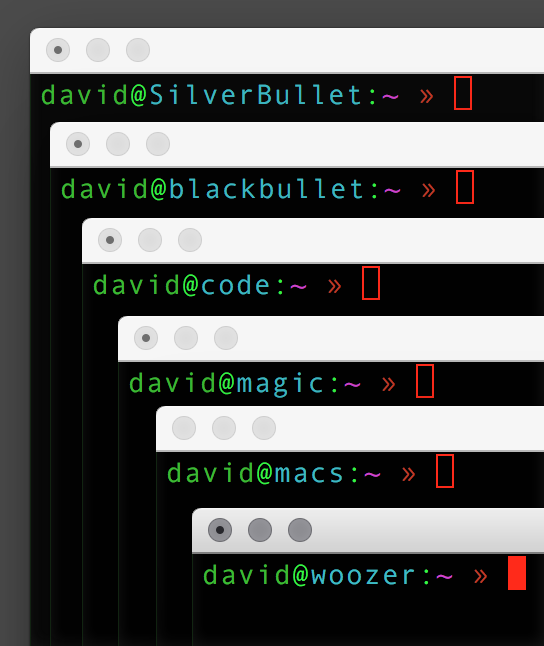
    computer names

    I’m not exactly sure why I do it, but I’ve acquired the peculiar habit of naming things over the years. I think that perhaps it’s a lot like the idea of a fisherman naming his boat for good luck. I’ve had names for not only automobiles, but household appliances like the coffee maker. I remember we had one that we called Malita… it was a piece of junk. The reason I’m writing this is that my wife and I were on the couch last night setting up a new hard drive under the television for storing music, movies, and Tivo recordings on, when I paused and said “what should we name it”. We spent the better part of the next twenty minutes discussing it. And while it’s a given that we name drives, servers and computers, I’ve actually put some thought into it in the past ( e.g. tweet ) and I tend to try and make the names meaningful. I’m pretty sure that while I anthropomorphize objects, I also lean toward mechanomorphism to explain the world around me as well. I don’t think it’s just me. I think we all tend to and others have suggested the same. Here is a research paper on the topic if you’re in for some dry reading.

    More recently, I’ve been naming the last couple machines after my deceased pets. I logged into and lined up my list of current computers and servers to the right. The last two names are my former pets. Macs was our family dog who died in the mid 90’s. He was a black colored pug and quite the character. I named my working laptop after him. I think it started as a play on the word Macintosh, but I only think about the dog now. Sometimes when I’m working, I’ll say “come on macs, what are doing?” I named my most recent server Woozer. I named it after my dog of 14 years that died earlier this year. Her name was Boozie, but we called her Woozie and Woozer. She was spunky, kind, and smart… just a great dog in every respect. Aside from it making talking to the computers easier, which I tend to do a good bit, I’m not exactly sure why I’ve been naming them. However, I can tell you that in this case it gives me a little smile every time I log into a machine that spits out my former pet’s name.
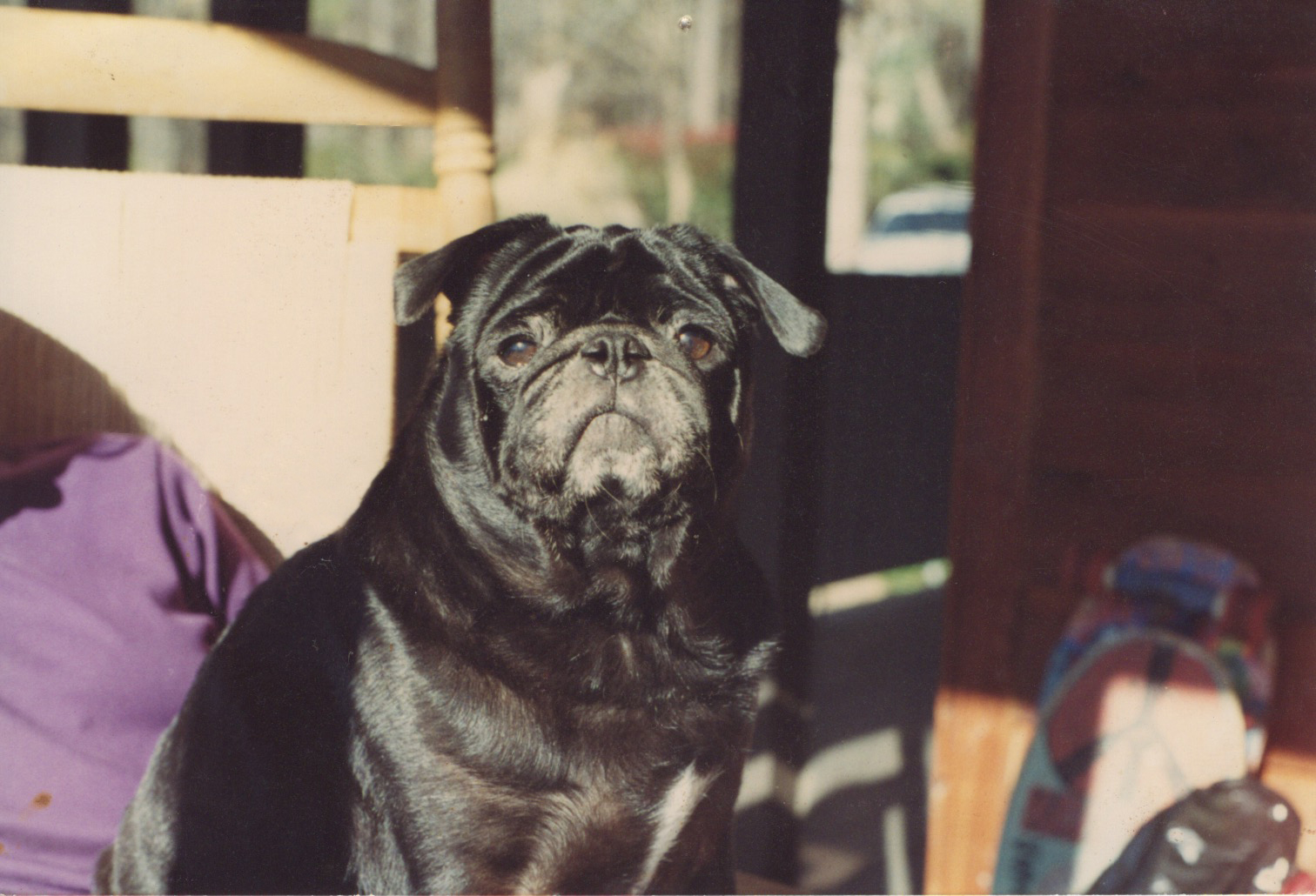
    macs

  • Listing Lists

    I am pretty obsessed with lists. Not in an obsessive kinda way, but in a really practical sorta use case scenario. Projects inevitably come down to lists. Every week I work on a shared grocery list with my wife. I make lists of music. I make lists of house chores. The list goes on … literally. That’s the motivation me keeping a page of the list to end all lists.

    awesome

    My list of lists was inspired by this Sindre Sorhus Awesome list ( https://github.com/sindresorhus/awesome )

    What makes this list awesome you ask …for those of you not stuck behind a terminal for work, let me try to quickly explain. Git is a version control system and in simple terms it’s a way to see revisions. Folks like Sindre Sorhus have been using Github in other ways than building software. One such way is making lists for other developers. What makes them awesome is that anyone can review, edit, comment and submit to a list. This sorta open forum makes them very accurate lists. I couldn’t possibly count the number of times that I’ve landed on someone else’s list while investigating another topic. And likewise I find myself asking my wife things like what was the name of that movie we saw that had x in it or what was that place we went? Just yesterday I found myself looking for something I’ve used several times. So I’ve followed the lead of those other list makers and I’m going to keep a list of lists for myself to reference and I’m going to keep in version control so that it’s easy for me to make edits and anyone else to suggest or comment on. I kinda doubt that one day I’ll look back on these and think what a waste of time. Let me know if you have any suggestions.

    The page will be right here: https://davidwindham.com/til/list

  • wp_title() deprecated

    I had a bit of free time today to run some upgrades on my computer and see what’s happening with this website. While doing so, I upgraded my localhost to WordPress 4.4 to test the new core-api features and I noticed that the wp_title() function is now throwing deprecated notices to the browser and log. ( e.g. https://make.wordpress.org/core/2015/10/20/document-title-in-4-4/ ) I used to use a custom function for my page titles, but it’s now handled by core in wp_head(). Since I know a lot of folks will be fishing for the answer on this once the upgrade is out, here’s how I rewrote my theme template.php.

    // ********* DEPRECATED wp_title() in 4.4 ***********
    //if ( ! function_exists( 'dw_page_title') ) :
    //function dw_page_title() {
    //	global $page, $paged; 
    //	wp_title( '|', true, 'right' ); 
    //	bloginfo( 'name' ); $site_description = get_bloginfo( 'description', 'display' );
    //	if ( $site_description && ( is_home() || is_front_page() ) )
    //		echo " | $site_description";
    //	if ( $paged >= 2 || $page >= 2 )
    //		echo ' | ' . sprintf( __( 'Page %s', 'dw' ), max( $paged, $page ) );
    //}
    //endif;
    
    function filter_wp_title( $title, $sep ) {
        global $paged, $page;
     
        if ( is_feed() )
            return $title;
     
        $title .= get_bloginfo( 'name' );
     
        $site_description = get_bloginfo( 'description', 'display' );
        if ( $site_description && ( is_home() || is_front_page() ) )
            $title = "$title $sep $site_description";
    
        if ( $paged >= 2 || $page >= 2 )
            $title = "$title $sep " . sprintf( __( 'Page %s', 'twentytwelve' ), max( $paged, $page ) );
     
        return $title;
    }
    add_filter( 'wp_title', 'filter_wp_title', 10, 2 );
    add_filter( 'document_title_separator', function () { return '|'; } );
    
  • My Mom

    I found this photo going through some old family slides. It’s a ‘selfie’ my mom took around 1976 or so.

  • Samuel David Minnick

    I took my mom to lunch for her birthday this week and we got to talking family. It’s pretty interesting putting the family tree together and I suppose that’s why all of the geneaology websites have proliferated. Several years ago I posted a photo of the Windham’s Crossroads in Darlington County, but I hadn’t posted anything on my mom’s side. I went to high school in a relatively small town and folks would come up to me and say things like we’re second cousins. I didn’t exactly understand it at the time, but all of the Derrick, Shealy, Metz, Koon, and Christmus(‘s) were generally related. I fit into that scheme via my mother’s family who had been around the Dutch Fork area of South Carolina. With the big football game coming up, it reminded me of a story I’d heard about my great grandfather on my mother’s side.
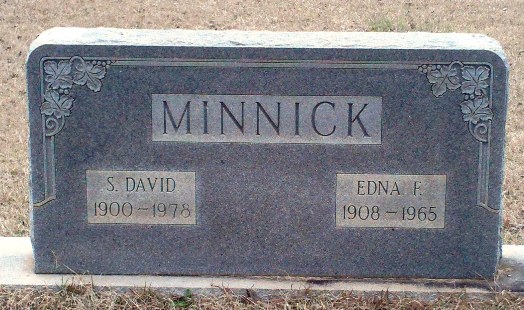
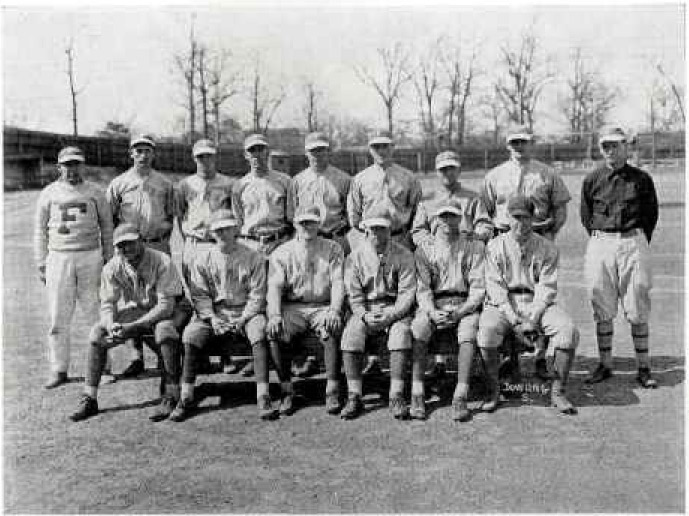
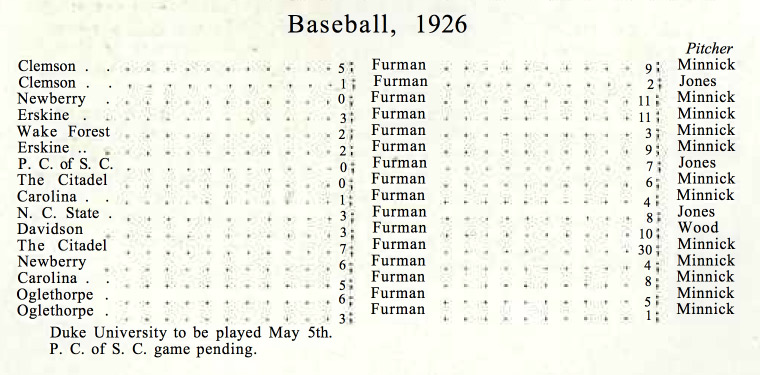
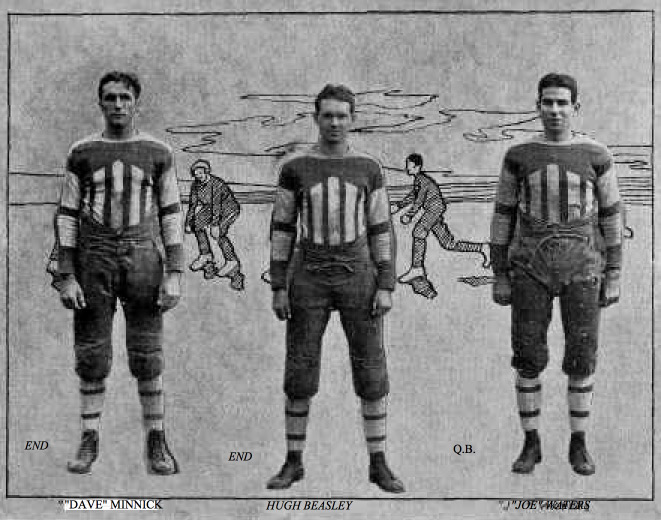
    Samuel David Minnick was born on June 1st, 1900 in Saluda County South Carolina. He graduated from Furman University in 1926 and worked as the State Officer for Standard Oil for 33 years living in and around where I live now. He pitched two winning seasons for the Furman baseball team. He also played on the football team who beat Carolina 10-0 and beat Clemson when he caught the winning touchdown on Thanksgiving Day. He married Edna Bell Fickling in 1926 and had one child, my grandfather Samuel David Minnick Jr.. He died in 1978 and is buried beside Edna Bell Fickling Minnick in Blackville, South Carolina.
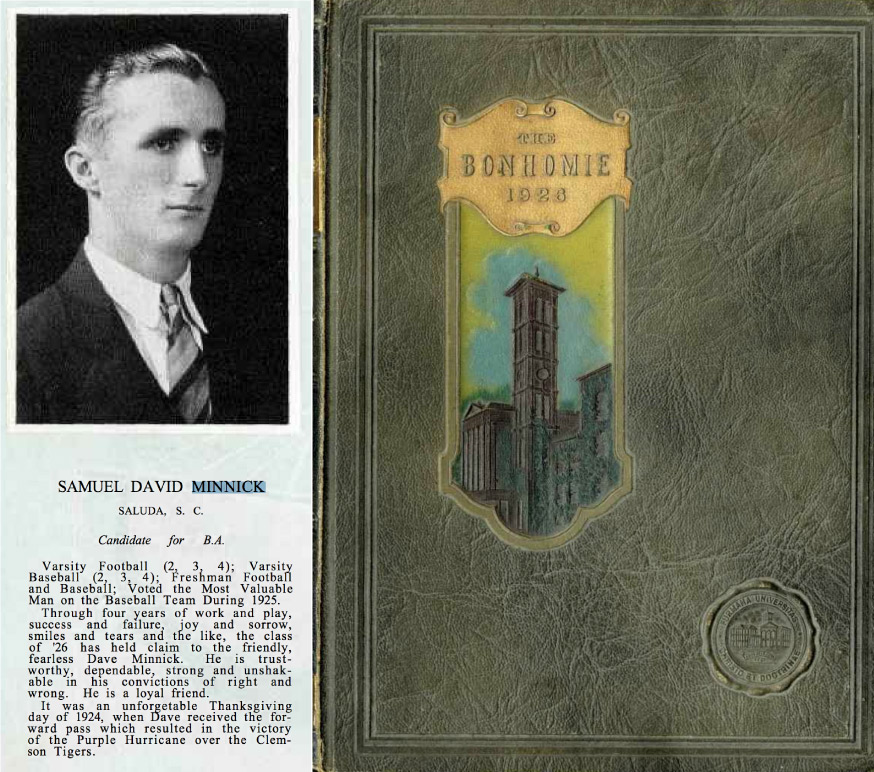
     
    Samuel David Minnick
     
    They don’t call it the information age for nothing. And while my folks are having fun scanning old family photos to put on Facebook, it’s a bit harder to find older material unless it’s been digitized by an organization. Our universities have been involved the South Carolina Digital Library 1 and the Digital Public Library of America 2. Furman University has been digitizing quite a bit of material 3. So next time you go playing genealogist, remember to start top down with established orgs that are digitizing content. Here are some other photos of my great grandfather from the Furman Bonhomie 1925-1926 yearbooks.
     
    Samuel David Minnick
    Samuel David Minnick
    Furman Baseball

    23/06/06 – Today I learned more about my great grandfather from a first person account1. I got an email from a fella who was discussing him with his 93 year old mother. I’ve added the contents of that email to the comment below and @ https://davidwindham.com/til/posts/dave-minnick . Since I’ve noticed a good bit of traffic to this page, I’ve also added citations so the outgoing links are more clearly listed.


    1. South Carolina Digital Library – https://scmemory.org
    2. Digital Public Library of America – https://dp.la
    3. Furman University Digital Collections Center – https://libguides.furman.edu/digital-collections/home-old
    4. David A. Windham – TIL – Dave Minnickhttps://davidwindham.com/til/posts/dave-minnick
  • Chrome Devtools Theme

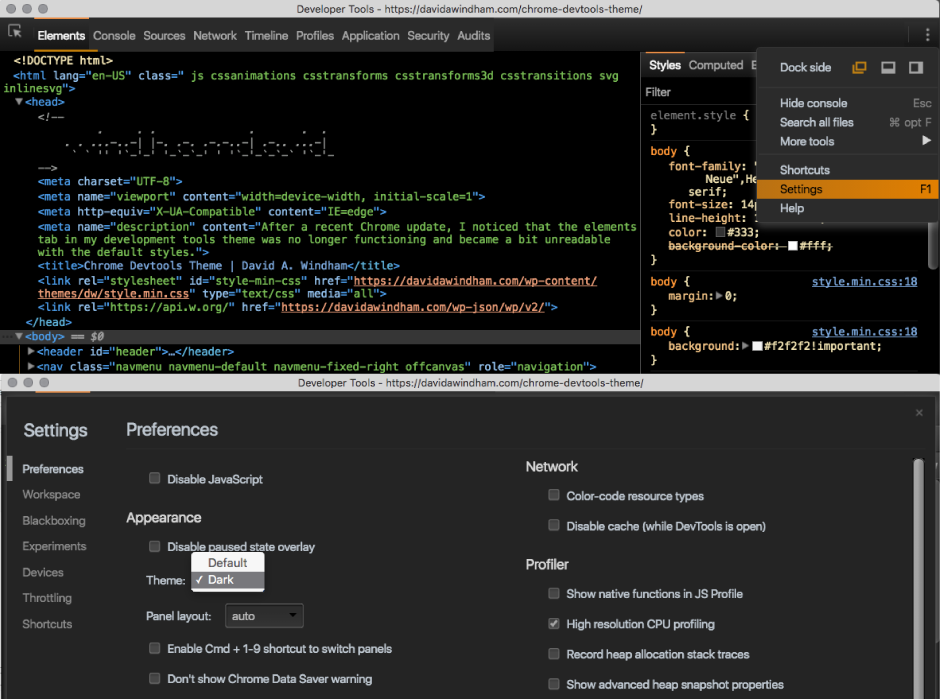
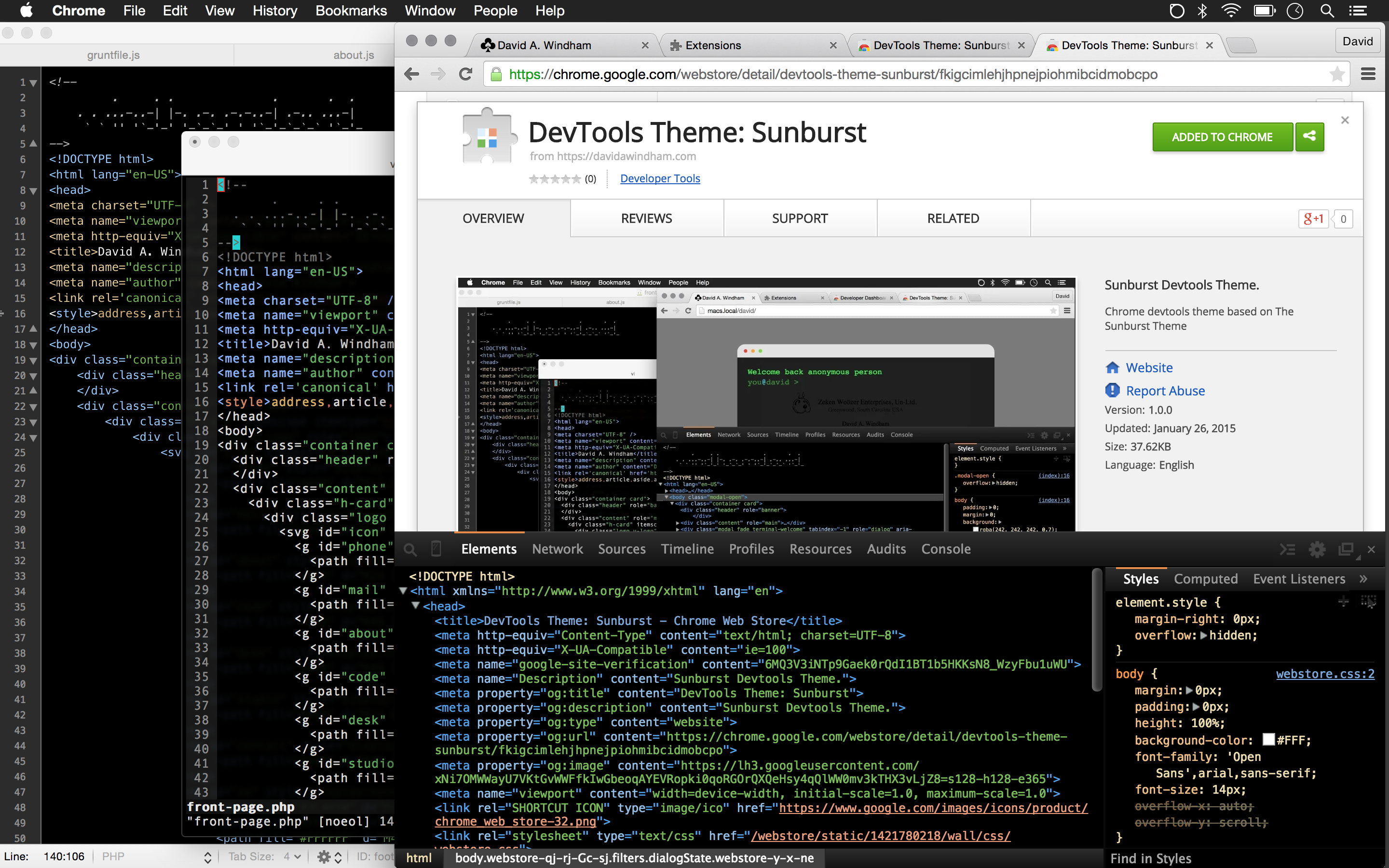
    After a recent Chrome update, I noticed that the elements tab in my development tools theme was no longer functioning and became a bit unreadable with the default styles. This also happened a year or so ago as well when Chrome stopped supporting the custom css rules for the development tools web inspector. I use Chrome, Safari, and Mozilla developer tools and I think each have nice debugging and consoles, but I’ve always been particularly fond of Chrome because I keep it customized to match my other editor themes. I’ve flipped themes over the years. I started on Notepad++ using a dark theme because it seemed to mimic a terminal window. I read an article about halation and switched back to a white background. I migrated over to Textmate and started using the Sunburst theme and the Menlo font. I switched to Solarized when that came out. When I was watching Railscast, I switched to that theme. When Sublime Text first came out, I switched to Monokai. I started using Atom and switched to Base16 dark. However, I always seem to switch back to Sunburst with the Menlo monospaced font and have continued to use that theme in every editor I use. I’m not exactly sure what it is I like. It could be just habit at this point but I can say that the cool blues, mellow yellows and oranges fit me just right.

    So I had to publish an extension that hacked the theme back into my development tools element inspector. The hackety-hack is in the pseudo ::shadow elements in the canary.css and the Github repo is available at https://github.com/windhamdavid/sunburst-devtools. The Google Chrome plugin is available at https://chrome.google.com/webstore/detail/devtools-theme-sunburst/fkigcimlehjhpnejpiohmibcidmobcpo
     
    Sunburst DevTools Theme


    devtools-settings

    Update: In February, the Chrome DevTools team updated the settings to include a dark theme. In your devtools window, go to settings and change it to a dark theme, which will eliminate a couple little areas of this custom theme that still had default Chrome colored tabs.


    Update: Another update to Chrome borked this developer tools theme. I had a bit of time this weekend to tinker with it and get it back rolling. The updated version is published at the Chrome Web Store and in my git repository. I couldn’t figure out why the ‘.webkit-html-external-link’ styling no longer has any effect so I’ve left it pale. I’ll leave commenting on below if you have any solutions.